Royal Visit to Ashton May 20, 1938

King George VI and Queen Elizabeth concluded their four days’ visit to Lancashire today with a tour from Knowlsey to Ashton-under-Lyne, and embracing: Wigan, Bolton, Radcliffe, Bury, Heywood, Rochdale and Oldham.

The King and Queen will set out this morning from Knowsley Hall, where they have been staying for the last two nights as the guest of Lord Derby, on the last stage of their tour of Industrial Lancashire. Today’s itinerary takes a zigzag course across the south-eastern part of the county, ending at Ashton-under-Lyne, where the King and Queen will entrain for London.

10:45am – Leave Knowsley hall and progress to Ashton-in-Makerfield.
11:10 am – Due Ashton-in-Makerfield, progress to Wigan.
11:33 am – Arrive Wigan Town Hall for presentations.
11:45 am – Leave Wigan for Bolton.
12:29 pm – Arrive Bolton Town Hall for presentations.
12:41 pm – Leave Bolton for Bury.
1:27 pm – Arrive Derby hall, Bury for presentations and lunch.
2:42 pm – Leave Bury via for Rochdale.
3:14 pm – Arrive Rochdale Town hall for presentations.
3:26 pm – Leave Rochdale for Oldham.
3:59 pm – Arrive Oldham Town Hall for presentations.
4:11 pm – Leave Oldham for Ashton-under-Lyne.
4:24 pm – Due Ashton Town Hall for presentations.
4:45 pm – Due Ashton Railway Station.

How Ashton Welcomed the King1

Lord Derby arrived in Ashton a few minutes ahead of the King and Queen. As the wireless message regarding his approach was received, his car was seen turning from Oldham road into Katherine Street, and a few minutes later he was being introduced to the Mayor and Mayoress and others on the platform. With the Town Clerk, he went over the list of people to be presented.

A THRILLING MOMENT

It was a thrilling moment when news was received that Their Majesties were in Ashton. Looking from the Town Hall, their car could be seen turning into Katherine Street. Flags were waved, and the cheering swelled into a deafening crescendo, as the car pulled up opposite the Town Hall entrance. The King and Queen were received by Lord Derby, the County Lieutenant, who presented the Mayor and Mayoress to them.

The Queen, smiling as she acknowledged the cheers of the dense crowd, was a radiant figure in a blue swagger two-piece with a hat to match. She wore a red rose on her left shoulder. The King, who looked well and fit, raised his hat in acknowledgement of the cheers.

The King broke off his conversation with the Mayor as the Regimental Band of the 9th Battalion, The Manchester Regiment played the national Anthem, and afterwards, with Lord Stanley, the hon. Colonel of the 9th Battalion, and Col. Barratt, the commanding officer, he inspected the guard of honour mounted by the Battalion, which had previously given the Royal Salute, under the command of Captain Hall. During the inspection, the Queen talked animatedly with the Mayor.

After the inspection, The King walked back to the platform and, with the Queen, ascended the dais on which two chairs had been placed for them. In front of the chairs was a blue carpet bearing the inscription “In commemoration of the crowning of King George VI, of Great Britain and Ireland, the Dominions beyond the seas, as King-Emperor of India, May 11, 1937. God save the King.”

The Presentations

After the presentations already named had been made, the following presentations were made by the Mayor to the King. Those to be presented sat on the right of the King and Queen, and as each was presented, after shaking hands with the King and Queen, they moved to the opposite side of the dais: –

The Deputy-Mayor, (Counsellor E. Meeks)
Borough Member, (Mr. F. B. Simpson and Mrs. Simpson)
Alderman R. S. Oldham, (Freeman of the Borough)
Alderman Col. J. Broadbent, (ex-Member for the Borough)
Alderman C. M. Bowden, (President, Portland House Social Centre)
Miss Margaret Bridge, (Matron, District Infirmary Ashton)
Miss A. Howard, (Matron, Ashton and District Sick Nursing Association)
Mr. Francis Dunn, (ex-Servicemen’s Association)
Alderman W. Wood, (National Gas and Oil Engine Co.)
Counsellor J. F. Davis
Alderman E. Broadbent, (President, National Chamber of Trade and hon. secretary Ashton Chamber of Trade)
Mr. J. Wolstencroft Jnr., (Secretary, Ashton and District Trades and Labour Council)
Mr. E. N. O’Hara, (Borough Treasurer)
Sir Charles H. Booth, (Magistrate’s Clerk)
Counsellor Mrs. M. E. Williamson, (President, Ashton Boy’s Club)
Rev. H. Whewell, (Rector and Rural Dean of Ashton)
Rev. G. A. Mitchell, (President, Ashton and District Free Church Council)
Father Bryan Hickey, (Roman Catholic Churches)
Mr. G. W. Fielding, (Secretary, Ashton and District Cotton Employers’ Association)
Mr. S. Howard, (Chairman, Limehurst Rural District Council) and Mrs. Howard
Mr. A. Brown, (Clerk, Limehurst Rural District Council) and Mrs. Brown

Royal Visit to Ashton May 20, 1938
“GOD SAVE THE KING!”

“GOD SAVE THE KING!” – Just after Their Majesties arrived at the Town Hall, the band of the 9th Battalion the Manchester Regiment played the National Anthem and everybody stood to attention. In the foreground will be seen the ladies-in-waiting to the Queen, Lord Stanley, Mr. A. Lascelles (the King’s private secretary), Colonel W. M. Barratt (1/9th Batt.), the Chief Constable (Mr. H. Dutton), Mrs. D. W. Bromley, the Town Clerk (Mr. D. W. Bromley), Lord Derby, the Mayoress (Mrs. J. Q. Massey), the Mayor of Ashton (Alderman J. Q. Massey), and Queen Elizabeth, King George VI, and Captain Hordern (Chief Constable of Lancashire).

After the presentations, the King and Queen walked over to the disabled ex-Servicemen, and spoke to a number of them.

SERVED IN HER BROTHER’S REGIMENT

“Oh! My brother2 was in the Royal Scots”, said the Queen to one of the disabled ex-Servicemen, Mr. Slater of Oaken Clough, Limehurst, after he answered her query as to the regiment he served in during the war.

Edwin Slater with King George VI and Queen Elizabeth
Ashton May 20, 1938

ROYAL SCOTS – In the foreground can be seen Mrs. and Mr. D. Bromley, (The Town Clerk), the Mayoress (Mrs. J. Q. Massey), the Mayor of Ashton (Alderman J. Q. Massey), and King George VI, Queen Elizabeth, and Mr. Edwin Slater M.M., (ex-Serviceman Royal Scots Regiment).

SHOWED QUEEN INVITATION TO PALACE

To ex-Private John Spicks, 80 Stockport Road, Ashton, who was blinded as a result of his war service whilst serving with the Shropshire Light Infantry, the Queen offered a few words of encouragement. When Mr. Spinks showed her an invitation he received to an entertainment in Buckingham Palace in 1916, the Queen emanated, “That was a long time ago.”

The Queen displayed an interest in the motor carriage in which sat Mr. Percy Sampson 13 Minerva Road, Ashton, and asked him how fast it could travel. In reply to the Queen’s questions Mr. Sampson told her that he was “knocked out” at Bethune in 1917 by an aeroplane bomb.

Royal Visit to Ashton May 20, 1938
With Disabled Ex-Servicemen

WITH THE DISABLED EX-SERVICEMEN – The King and Queen spent a few minutes talking with the disabled ex-Servicemen, who were given a place of honour on the right of the dais.

“What speed do you travel in your motor carriage?”, was one of the questions Queen Elizabeth asked of Mr. Livensy of 91 Timperley Road, Ashton, who served in the war in the King’s Liverpool Regiment, lost both his legs, had fifteen wounds and also sustained a broken jaw.

The Queen smiled when he replied, “Thirty miles per hour, when no one is looking!”

HOPED TRADE WOULD IMPROVE

In the course of the short talk which she had with him, the Queen told the Mayor that she thought Lancashire people were “wonderful” and that both she and the King had been impressed by the welcome they had received.

When the Mayor offered a compliment by remarking that the Scotch were also wonderful people the Queen replied, “Yes, they make a good combination.”

Told by the Mayor that the trade of the town was not as good as he would like to see it the Queen said she hoped it would soon improve.

The Queen said she was feeling rather tired after the tour and when the mayor said that she would, no doubt be glad to be able to return to the Princesses she said, “Yes, they are longing to see me.”

The King told the Mayor that he would take back with him happy memories of his visit to Ashton and expressed the hope that prosperity would return to the town.

BOUQUET NOT PRESENTED

It was intended that the Mayoress should present a bouquet of red roses to the Queen. Lord Derby, however, said that a rule had been made that no bouquets should be accepted throughout the tour. He promised that if the bouquet were placed in his car he would see that it was forwarded to Buckingham Palace.

After their conversations with the ex-Servicemen the King and Queen walked slowly back to the platform and stood for a moment acknowledging the cheering. Then they re-entered their car to a renewed burst of tumultuous cheering and drove away in the direction of Charlestown Station.

Queen’s Appreciation of Bouquet

In the handwriting of Lady Katherine Seymour, one of the Queen’s ladies-in-waiting, the Mayor has received the following letter:

Buckingham Palace

“Dear Mr. Mayor,

The Queen commands me to write and convey to you her Majesty’s warmest thanks for the beautiful bouquet which you so kindly presented to the Queen at Ashton-under-Lyne yesterday afternoon.

The Queen was deeply touched by your charming thought of presenting the red roses of Lancashire to Her Majesty and the lovely flowers remind her most happily of Their Majesties’ memorable tour of Lancashire this week.

The Queen hopes so much that you were not unduly tired after receiving Their Majesties, as she fully realizes what efforts you must make to overcome your great infirmity.

The Queen does indeed appreciate your lovely bouquet of red roses.”

“Deeply Moved”

Lord Derby has sent on to the mayor a copy of the following letter which he has received from the King:

“The Queen and I are deeply moved by the loyal and enthusiastic reception so characteristic of the County Palatine that has been given to us during the past four days.

Will you please convey our heartfelt thanks to the people of Lancashire who, in sunshine and in rain, came in their thousands to bid us welcome with a warmth of affection that we shall never forget.

I appreciate that the arrangements for our visit could not have been as perfect as they were without a great deal of forethought and organization on the part of those entrusted with them. I send my hearty congratulations on their success to you and to all those who co-operated with you.”

The King’s Thanks

The Chief Constable of Ashton has received the following letter from the Chief Constable of Lancashire (Capt. Hordern):

“Dear Mr. Diston, Lord Derby has asked me to let you know that he has received the following telegram from the private Secretary to H. M. the King: –

“The King will be grateful if you will convey to all Chief Constables concerned, and to the members of their respective forces, His Majesty’s high appreciation of the services they have rendered while he was in Lancashire. Throughout the visit all the arrangements were, His Majesty considers, admirably planned and admirably executed.”

THE KING AND QUEEN END THEIR TOUR 3

The King and Queen ended their tour of Industrial Lancashire yesterday in perfect weather. They saw the mining and cotton towns of the county’s least attractive district bathed in sunshine, with a cloudless sky overhead, a kindly heat-haze shrouding the scarred and blackened landscape and an unwonted wealth of brilliant colour disguising the somber drabness of the streets and public buildings.

The day’s drive started at Knowsley Hall, where the King and Queen had been staying for the last two nights as the guests of Lord Derby. The procession was due to leave the park at 10:45, and as the zero hour drew near the pressmen who were to accompany the royal party were given an insight into the exceedingly thorough and complex precautions taken by the Lancashire County Police to ensure that the carefully planned programme should be carried through with the smoothness and precision of clockwork.

A police plane zoomed overhead, and on the radio of the control car in the park we heard its officer exchanging calls with stations at various points on the route. The advance pilot car, a big grey sports model with a large yellow circle on its tonneau cover, set off at 10:35, and the wireless operator warned the ‘plane the “X 50” – the royal landaulet – was ready to follow in a few minutes.  And so all through the journey the procession kept constantly in touch with patrols on the route ahead with the all-seeing occupants of the circling ‘plane ready for any emergency and assured of an unobstructed passage.

A TASTE OF SPEED

The royal car drove off, with hood down, some ten minutes late, and it is a tribute to the organization behind the nicely calculated time-table that it maintained this margin, within three or four minutes, all the way to Bury. Lines of chambermaids and scarlet-liveried footmen cheered the royal guests as they left the hall, and knots of labourers clustered behind the park railings at intervals to give them a farewell wave. Soon the procession had turned into the East Lancashire Road, and on our speedometer showed forty, fifty and sixty miles an hour.

But this rapid progress was possible only on short stretches, for at frequent intervals were stationed policemen holding red flags, to indicate a section where spectators could congregate to see the King and Queen pass slowly by. For two or three miles on either side of Ashton-in-Makerfield our speed was reduced to a crawl by the throngs of flag-waving school children and miners, who encroached on the roadway in almost uncontrolled but orderly enthusiasm. Even the window-frames of a half-built house were decorated with welcoming banners.

WIGAN’S WELCOME

As we approached the centre of Wigan the banks of school children lining the route grew broader and denser, their agitated flags became a dancing haze of colour, and church bells pealed above their vociferous greetings. In the Market Square the caravan drew up, and the King and Queen were received by Lord Derby, who had driven on ahead. Twenty thousand people sang “God Save the King” at widely differing speeds, and drowned its irregular conclusion in a hearty cheer. The King inspected a guard of honour provided by the Fifth battalion the Manchester Regiment, and then the Queen and he chatted with a number of crippled but proudly be-medalled ex-servicemen.

The Mayor presented a number of civic notables, and in less than ten minutes the cars moved off again on the Bolton road. Here, in depressed mining villages, surrounded by ugly slag-heaps and starkly motionless winding gear, the crowds were thinner and less exuberant in their welcome. There were gloomy faces in the groups of clog-shod colliers, as well as among the vendors of flags and favours whose hopes of further sales were ended by our arrival. And it was here, on a deserted stretch of road near Deane, that the first mishap of the day occurred.

The second royal household car, containing Lord Stanley, Mr. A. Lascelles (the King’s private Secretary), and a detective, suddenly drew into the side of the road, and for a moment the rest of the procession halted, while the police pilot car and the royal landaulet passed rapidly out of sight. Immediately the occupants of the car which had stalled jumped into one of the others, and the procession had reformed itself before the leaders entered Bolton. The defect – a fault in the petrol feed – was quickly remedied, and the car resumed its proper place when the party reached Bolton Town Hall.

At the boundary of Bolton mounted policemen met the party and trotted alongside the cars. When the royal car had passed one of the horses began to prance, but the officer quickly brought his steed to order.

In Bolton, the lines of cheering people were still more exuberant, and still less subject to official restraint. Constables were stationed more than a hundred yards apart in most of the streets, but the children resisted the temptation to push their flags through the press-car windows as we crawled at a snail’s pace through the narrow space allowed us.

“WRITE ME A LETTER”

As before, the King and Queen were received by Lord Derby and proceeded to inspect the guard of honour and ex-servicemen. One of the latter, Mr. J. Taylor, told the King that the local association for limbless veterans had ceased to exist. “It is twenty years since the war“, he added, “and none of us are getting any younger. We should like free passes on the corporation trams and buses, as they have in other towns.” “Well”, answered the King, “you must write me a letter about it” – which Mr. Taylor promised to do.

The presentations were made under a gorgeous canopy of blue and yellow, flanked by masses of flowers, and there were hundreds of people watching and taking photographs from the rooftops opposite, besides the thousands that thronged the square and filled the windows.  Before they left Bolton the King and Queen were greeted by a large board, bearing the words “You’re Gradely Welcome,” which was attached to a girder hanging from a crane beside the framework of a new building.

And so it went on, through Farnworth, Ringley, Stand and Radcliffe with everywhere flags, crowds, cheers, and hordes of children. Near Ringley Station the same royal car developed the same unfortunate trouble as at Deane, but otherwise the royal progress was without untoward incident.

By this time one had gained some sympathetic inkling of the trials and hardships suffered by a King on these occasions, when he must try to appreciate that for nearly every person in these endless crowds his passage is an exciting event, joyfully anticipated and long remembered, whereas to us who saw them from the moving cars their uniform appearance ad interminable cheers became so tedious that we almost jumped with relief and delighted surprise when we entered Bury – and found the school children waving coloured handkerchiefs instead of Union Jacks.

DIED AFTER MEETING THE KING

Less than three hours after he had shaken hands with the King and Queen at Bury yesterday, Herbert Fearing (52), a disabled ex-serviceman, of Buller Street, Bury, collapsed and died at his home while describing his experiences to his wife.

He served with the 15th Lancashire Fusiliers at the Gallipoli landing and was badly wounded.

Notes:

  1. This is an excerpt from an article that was originally published in the Saturday May 27, 1938 edition of the Ashton Reporter. It has been gently edited and slightly reformatted for accuracy and clarity. [back]
  2. The Queen’s brother, the Hon. Michael Claude Hamilton Bowes-Lyon, (“Mickie”), was a 2nd Lieutenant in the 3rd Battalion Royal Scots Regiment at the outbreak of world war one. Eventually, he was promoted to Captain with the 16th Royal Scots and while serving with them was a German Prisoner of War from April 28, 1917 to Nov 29, 1918. [back]
  3. This is an excerpt from an article that was originally published in the Saturday May 21, 1938 edition of the Manchester Guardian. [back]
 

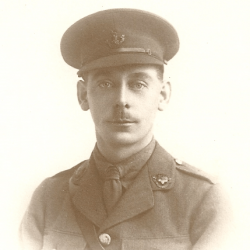
Pte. Percy Wheldon

Percy Wheldon was born on January 4, 1895 in Little Eaton, Derbyshire. In 1911 he was living with his parents and older brother and sister at 34 Mansfield Street, Derby. He was 16 years old and working as an Iron Moulder.

He attested on May 12, 1915 and, after going through basic training, joined the 1/5th Sherwood Foresters with service number 4322.

Pte. Percy Wheldon 1/Sherwoods

He landed in France on March 23, 1916 and spent a month at Rouen before joining the Battalion on April 10th. He was wounded in action on July 1st with a shrapnel wound to the right shoulder. He was admitted to Hospital in Dieppe and discharged to Base Depot at Etaples a week later. Six weeks later he was re-admitted and eventually transferred back to England on September 19, 1916.

He was transferred to the 2/8th Sherwoods on January 24, 1917 and joined them in the field in France in February. He spent 3 weeks in a Field Ambulance in July and August 1917 with septic abrasions on his feet. And a week in a different Field Ambulance with scabies in September. Evidently still unwell after 3 months of hospital treatment a week after he rejoined his unit he was charged with neglect of duty (presumably sleeping) while on duty in the Battalion Signals Office and given 21 days of Field Punishment No. 1.

Field Punishment Number 1 consisted of the convicted man being shackled in irons and secured to a fixed object, often a gun wheel or similar. He could only be thus fixed for up to 2 hours in 24, and not for more than 3 days in 4, or for more than 21 days in his sentence. This punishment was often known as ‘crucifixion’ and due to its humiliating nature was viewed by many as unfair.

He spent another two weeks being treated for bronchitis in November.

The 2/8th Sherwoods were disbanded in France in February and Pte. Wheldon ended his unhappy association with them by transferring to the 1st Sherwoods on January 29, 1918. But his medical troubles were not over and he spent another 12 days in 24 Field Ambulance being treated for scabies.

The 1/Sherwoods were part of the 24th Infantry Brigade of the 8th Division. Pte. Wheldon was one of 260 Other Ranks added to the Battalion in January and February as they reorganized and trained their new additions. The German Spring Offensive interrupted these activities and the 1/Sherwoods fought in the First Battle of the Somme, 1918 in March where Pte. Wheldon was briefly reported missing on March 26th. Evidently he really was just temporarily unaccounted for because he was back with his unit on May 27, 1918 when he was taken prisoner in the Boise de la Miette along with Pte. Arthur Slater and and Pte. Christopher George Zabel in the 3rd Battle of the Aisne.

Pte. Arthur Slater and Pte. Percy Wheldon. Prisoners of War.
Ready to go on the 2pm Shift at SAG Lipine Labour Camp. Oct 1918.

He was repatriated to the UK on January 16, 1919 and was demobed from the Army on March 13, 1919. Shortly after he returned to the UK he sent Arthur Slater the photograph shown at the top of this post and on the back wrote, “From an old Gefangenen” (German for Prisoner).

Pte. Sydney Caine

Sydney Caine was born on January 24, 1893 in Ashton-under-Lyne. In 1911 he was a 16 years old Grocer’s Assistant living at 48 Cranbrook St, Ashton with his parents and his three younger brothers: Arthur Edward Caine, George Rayner Caine and Leonard Caine.

In April 1913, his brother Arthur Edward Caine went to Victoria, British Columbia, to stay with their half-brother Percy Caine who had emigrated there in 1901. Not long after the outbreak of war, Arthur returned to England arriving in Liverpool on January 24, 1915.

9th Manchesters

Syd Caine joined the 9th Battalion, Manchester Regiment on October 17, 1914 the same day as his best friend Arthur Slater. His service number was 2680. They underwent basic training with the 2/9th Manchesters at Southport and on July 5, 1915 sailed to Gallipoli arriving on the 23rd. They fought in the Battle of Krithia Vineyard in early August and endured the brutal front line trench warfare and harsh conditions that followed.

On September 22nd Syd was admitted to the Number 11 Casualty Clearing Station with jaundice and evacuated from the peninsula on the Hospital Ship Ausonia, arriving in Malta on September 28. He rejoined the Base Depot at Alexandria on December 7th and was classified fit for active service (Class A). He was then shipped to Mudros where he rejoined the Battalion on January 3, 1916 after they had left Gallipoli for good. The 9th Battalion, Manchester Regiment sailed from Mudros to Egypt in late January 1916 where Syd spent the next year with them defending the Suez Canal from attack by the Turks.

Royal Navy

Back home in Ashton, Syd’s brother George had enlisted with the Royal Navy on September 16, 1915 and his brother Arthur followed him on January 4, 1916. Both of them underwent basic training at the Naval Barracks at Devonport before being deployed to their respective ships; George to HMS Collingwood on December 4, 1915 and Arthur to HMS Indefatigable on  April 9, 1916. Back in Canada, their half-brother Percy Caine joined the 103rd Battalion, Canadian Expeditionary Force on December 11, 1915 and deployed to England in June 1916 where he served in a support role at Seaford and Hastings until returning to Canada in 1918.

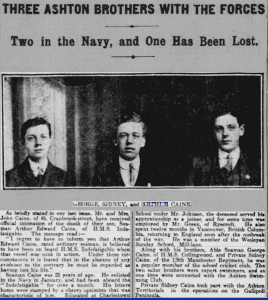
On May 31, 1916 Arthur Edward Caine’s ship, HMS Indefatigable, was sunk with the loss of all but 3 hands at the Battle of Jutland. HMS Collingwood was also there and George must have witnessed his brother’s ship being hit, exploding and sinking. Their parents received the following message from the Admiralty:

“I regret to have to inform you that Arthur Edward Caine, rated ordinary seaman, is believed to have been on board H.M.S. Indefatigable when that vessel was sunk in action. Under these circumstances it is feared that in the absence of any evidence to the contrary he must be regarded as having lost his life.”

The Saturday June 17, 1916 edition of the Ashton Reporter carried the following tribute the Caine brothers’ military service:

George, Sydney and Arthur Caine
Ashton Reporter June 17, 1916: George, Sydney and Arthur Caine

Egypt 1916

Back in Egypt, Syd served with the 9th Battalion, Manchester Regiment Scouts along with his old friend Arthur Slater.

Regimental Scouts Bir el Abd October 1916

In November 1916 Syd injured his left knee and was admitted to 31st General Hospital in Port Said. Syd spent two months in hospital rejoining the 42nd Division Base Depot in Alexandria on January 8, 1917.

Royal Engineers

Shortly after rejoining the Division Syd was sent to Signals School for a month subsequently joining the Signals Company. Meanwhile the 42nd Division sailed for France on March 4, 1917 leaving Syd in Egypt.

A month later he was admitted to the Citadel Hospital in Cairo with a broken collar bone and was discharged 4 weeks later on April 11th. He spent the next 4 months at Serapeum, Cairo and on August 17, 1917 was officially transferred from the 1/9th Manchesters to the 3rd East Lancs Royal Engineers, Territorial Force with service number 443872. He remained with them in Egypt for the duration of the war sailing back from Port Said on March 18, 1919 aboard the HMT Magdelena.

He was discharged from the Army on April 9, 1919 his papers noting that he was sober, intelligent, reliable and industrious. Back in Ashton-under-Lyne he became a civil servant and is said to have helped his old friend Arthur Slater obtain a job at the Labour Exchange.

Arthur Slater and Sid Caine
« of 4 »

He married Eleanor (Nellie) Knowles, a felt hat trimmer, in October 1921 and they moved to 23 Clarendon St, Dukinfield.

Sid & Nellie Caine1926

Sydney Caine died on March 15, 1968, two months after his best friend Arthur Slater. He was 75 years old.  Syd’s wife, Nellie, lived to be 94 years old.

Acknowledgements:

Special thanks to Gillian Aldred (née Caine) who provided the Ashton Reporter newspaper article and highlighted the Caine brothers’ Naval Service.


First Battle of the Somme, 1918

This action is variously referred to as the Second Battle of the Somme, the First Battle of the Somme 1918 and also known as the Battle of Saint-Quentin, (March 21–April 5, 1918).

Order of Battle

5th Army
XIX Corps
8th Division

Summary of Events

Early in the morning of March 21, 1918 the Germans attacked the allied lines during the opening of Operation Michael of the Spring Offensive. As the Germans pushed forward the 8th Division was moved from Flanders to the SOMME to do what it could to stem the tide. The 1/Sherwoods dug in on the West bank of the SOMME and defended the bridge at St. Christ on the evening of March 23rd. The next few days saw the 1/Sherwoods engaged in dogged resistance, followed by ordered withdrawal and then finally counter-attack. By the end of the engagement the 8th Division had fulfilled its duties but had suffered significant casualties.

The map below shows the front line positions (at 6am in blue and 6pm in red) each day during the battle. The Germans pushed Eastwards towards Amiens from the top right of the map to the bottom left.

1st Battle of the Somme, 1918
Crown Copyright

March 22, 1918

The Battalion took up a defensive position on the river SOMME at ST. CHRISTE BRIOST.  There were no reported deaths this day.

1st Battle of the Somme, 1918
March 23 -26

March 23, 1918

The Battalion was holding a line along the river, the centre of the line being at the village of ST. CHRISTE BRIOST. At 9pm the Germans attempted to cross the partially blown bridge.  By 10pm they had a foothold on the other side but were unable to progress due to the stubborn resistance of the 1/Sherwoods.

During the fighting at least 7 men lost their lives:

Rank No Forenames Surname
Pte 96655 CEDRIC NORMAN BUNN
Pte 32369 HARRY HARPER
Pte 102115 HENRY J. MEESE
Pte 102113 HAROLD METCALF
Pte 102122 FRANK NORMANTON
Pte 307291 ALBERT ROGERS
Pte 70758 ARTHUR STOKES

March 24, 1918

A counter-attack against the Germans began shortly after midnight on the 23rd pushing the Germans back over the bridge. The C.O., Lt. Col. WATSON, was killed by Machine Gun fire (Lt. Col. R. F. MOORE took command). In the evening of March 24th the Germans attempted raids against two posts of the 1/Sherwoods but were, in both cases, beaten back with several of them killed or captured.

At least three other men were killed in action:

Rank No Forenames Surname
Pte 306549 JOHN FREDERICK HUNT
L/Cpl 43601 A WATERLAND
Pte 306763 JAMES WING

March 25, 1918

Soon after dawn the Battalion on the right of the 1/Sherwoods was ordered to withdraw leaving their flank open.  However it was not until 4pm that the 1/Sherwoods received their orders to withdraw and by this time they were partially surrounded by enemy troops. Nevertheless, they fought their way out, bringing all their wounded with them, and rejoined the Brigade at MISERY. After some reorganization the Battalion then took up a position at ESTREES under the provisional orders of the 23rd Infantry Brigade.

At least 9 men were killed in action this day:

Rank No Forenames Surname
Pte 2992 RICHARD THOMPSON
Pte 100064 ARTHUR E. EVERITT
Pte 80022 ARTHUR WOODWARD
Sjt 266580 HARRY BATTISON
Pte 97350 JOSEPH DAVISON
Pte 31333 FREDERICK HALL
Cpl 67108 JOHN WILLIAM HAMES
Pte 85889 HERBERT NEWTON
2/Lt. GEOFFREY STAMPER

March 26, 1918

At 3am, under orders, the Battalion withdrew to VERMANDOVILLERS. Here orders were received to march to a position S.W. of LIHONS under orders of the 25th Brigade, which was completed by Noon.  About 4 hours later, orders were again received to withdraw to ROSIERES EN SANTERRE as Support Battalion. The night was spent at ROSIERES EN SANTERRE.

1st Battle of the Somme 1918 (March 26)
Crown Copyright

Despite the ordered withdrawal, this was a bad day for the Battalion with at least 36 men losing their lives:

Rank No Forenames Surname
Pte 203228 JAMES HENRY DOBSON
Pte 97879 WILLIAM ALLISON
Pte 97369 HAROLD REGINALD BLOW
Pte 202960 THOMAS HENRY BOYDEN
Pte 82988 HAROLD BULLIMAN
Pte 72688 OWEN STANLEY BURCHELL
Pte 93801 FREDERICK COLCLOUGH
Pte 306917 B COX
Pte 100100 CHARLES DONALDSON
Pte 97390 HARRY SIMPSON ELLIOTT
Pte 93562 CHARLES GREENWOOD ELLIS
Pte 83530 JOSEPH EVANS
Pte 97410 WILLIAM FINNEY
Pte 71954 STEPHEN GREENER
Cpl 204852 ARTHUR GUISE
Pte 100070 JOHN G. H. GUY
Pte 24519 W HARRISON
Pte 242296 FRED LAZENBY
L/Cpl 235039 NORMAN VICTOR LEWIS
Pte 72666 GEORGE MEESON
Pte 18853 CLARENCE MIDDLETON
L/Cpl 32382 GEORGE MILLS
L/Cpl 307157 HENRY MOYNIHAN
Pte 72644 EDWARD G. B. PELL
Pte 97429 ALFRED PLATT
Pte 96326 ERNEST POWELL
Cpl 80036 GEORGE RICHARDSON
Cpl 5080 WILLIAM RUDGE
Pte 22055 GEORGE TASKER
Pte 202514 ERNEST JACKSON THORPE
L/Cpl 31842 WILLIAM WALL
Pte 18246 GEO ROBERT WALLEN
Pte 266609 WILLIAM HENRY WHITBY
L/Sjt 15717 THOMAS WILD
Pte 19667 J WILSON
L/Sjt 6523 FREDERICK CHARLES RIDLER

Additionally, at least one man, Pte. 70069 William Charles Norgate, was taken prisoner by the Germans this day.   Pte. Norgate was wounded and from here he was transported to a Kriegslazarett, (a German military hospital), at Maubert Fontaine where he eventually died and was buried on April 27, 1918. His remains were then subsequently moved to the Cemetery at Sedan-Torcy around 1923.

March 27, 1918

At 7am, the Battalion took up a position in support of the front line at VRELY. At 2pm orders were received to take part in a counter attack on HARBONNIERES which was successful and the Battalion then took up a position East of HARBONNIERES.

The following men lost their lives that day:

Rank No Forenames Surname
Pte 27482 WILLIAM SMITH KNAPP
Pte 204720 P PEARSON
Pte 70024 WALTER PEARSON
Pte 235173 W PEDLEY

March 28, 1918

At 4am the Battalion withdrew, under orders, to a position West of ROSIERES EN SANTERRE. Germans pushed on both flanks all day and around 4pm the Battalion withdrew through CAIX and BEAUCOURT EN SANTERRE to MOREUIL and then to billets in JUMMEL.

1st Battle of the Somme, 1918 - 28 March
Crown Copyright

The following men lost their lives that day:

Rank No Forenames Surname
Pte 100065 GEORGE EDWIN FOREMAN
Pte 97384 R HANDY
L/Cpl 7810 CHARLES WHARMBY

29 March – 2 April, 1918

The Battalion spent the day of the 29th March resting and recuperating in reserve billets.  At 7pm on March 30th the Battalion took up a position on the front line NW of MOREUIL. From this point on, until they were relieved on April 2nd, they remained holding the line N.W. of MOREUIL.

The following men lost their lives during the final days.

Rank No Forenames Surname
Pte 100078 CHARLES WILLIAM LINES
Pte 97929 JAMES WILLIAM ROSCAMP
Pte 269864 A O FOSTER
Pte 71776 HORACE BUGBY
Pte 11580 JAMES ROBEY

By the time the battle was over the 1/Sherwoods had fulfilled their duty but paid a heavy price. Fully 379 Officers and men were officially listed as killed, wounded or missing.

GALLANTRY

Sergeant William Russon (12276) was awarded the Distinguished Conduct Medal.

Sjt. William Russon, DCM

The Commanding Officer, Lieutenant Colonel R. F. Moore, MC was awarded the Distinguished Service Order and the following Officers received the Military Cross (Capt. WESTON receiving a Bar to his existing M.C.).

Rank Forename MI Surname Honour
Capt. WILLIAM WESTON Bar to M.C.
2/Lieut. WILLIAM LESLIE GREEN M.C.
2/Lieut. HAROLD EMBLEM* M.C.
2/Lieut. ALFRED OLIVER JACKSON M.C.

* 2/Lieut. HAROLD EMBLEM was subsequently killed in action on April 23, 1918.

And the following men of the 1/Sherwoods were awarded the Military Medal for their gallantry during the operations west of the SOMME during the period of March 22, 1918 to April 2, 1918.

Rank Service No Forename MI Surname
CSM 9291 ALFRED B LEIVERS
Sgt 5810 OLIVER CLARKE
L/Cpl 4938 GEORGE H BULLARD
Pte 12388 ROBERT H HARRISON
Pte 28823 JACK CHAPMAN
Pte 26139 WILLIAM F PETERS
Pte 19955 WILLIAM SPOONER
Pte 18681 ERNEST DODSLEY
Pte 13426 WILLIAM H DARROLL

REFERENCES

Divisional narrative from the 8th Division War Diary: Divisional Headquarters, 8th Division, Piece 1678/1-3: Headquarters Branches and Services: General Staff (1918 Jan – Jun).

Narrative
Crown Copyright
« of 24 »

History of the Great War, Military Operations France And Belgium 1918 Vol-I, BRIGADIER-GENERAL SIR JAMES E. EDMONDS.

Second Battle of Villers-Bretonneux

Summary of Events

The 1/Sherwood Battalion moved on April 12th 1918, eventually going into the front line on April 19th, at VILLERS-BRETONNEUX. They were relieved on the evening of the 23rd and marched back to reserve billets in BLANGY TRONVILLE. At 3:45am on the 24th the Germans began a frontal assault, under cover of mist and smoke, and had successfully penetrated the Allied lines at VILLERS-BRETONNEUX by 9:30am. The 1/Sherwoods were immediately put under the temporary command of the 23rd Infantry Brigade and were ordered to launch a counter-offensive attack at 10am.  Fighting continued until the night of the 27th when the 1/Sherwoods were relieved but the counter-offensive was successful and VILLERS-BRETONNEUX was recaptured with the Germans driven from all their positions. However the toll on the Battalion was heavy and 234 men were officially listed as Killed, Wounded or Missing.

Order of Battle

Fourth Army
III Corps

  • 8th Division
  • 18th (Eastern) Division
  • 58th (2/1st London) Division

Australian Corps

  • 4th Australian Division
  • 5th Australian Division

The Defensive Scheme

The 8th Division was flanked by the 5th Australian Division to their left and the 58th Division to their right, (North and South respectively on the map below).

Behind the front lines a permanent garrison was stationed in VILLERS-BRETONNEUX forming a reserve line extending South along the CACHY Switch.  Additionally, two rear lines were formed using existing trench systems; namely the NICHOLAS-BLANGY line and TRONVILLE Switch (shown in brown), and the GLISY line (shown in green).

Villers-Bretonneux Defensive Lines
Crown Copyright

A comprehensive defensive scheme was issued by the Divisional commander to the Brigade commanders. The key point being the layered defensive lines and the requirement to launch an immediate counter-attack in response to any hostile action by the Germans.

Page 1
Crown Copyright
« of 6 »

The 1/Sherwoods went into the Front Lines, on the Southern divisional border, on the evening of April 19, 1918 and completed their move by 11:30pm. On the 20th, C Company captured two German prisoners from the German 93 R.I.R.  One of them, a Serjeant-Major, stated that a German attack was planned for the early hours of the 23rd April, around 3am. The Battalion positions at 9am on April 21, 1918 were as shown below, (the 1/Sherwoods in yellow at the bottom right).

Villers-Bretonneux April 21, 1918 @ 9am
Crown Copyright

The reported German attack did not materialize and nothing else of operational note occurred during their time holding the front line. They were relieved by the 2nd West Yorks on the evening of the 23rd April, the last Company reaching the reserve billets at BLANGY TRONVILLE at 2am in the early hours of the 24th. Although they had a relatively quiet time at the front it is worth noting that 9 men and two Officers of the 1/Sherwoods were killed during these few days. Barely a taste of what was to come.

Rank Service Number Forename MI Surname Age DoD
2/Lt. GEOFFREY V MARRIOTT 22-Apr
2/Lt. HAROLD EMBLEM 20 23-Apr
L/Cpl 108910 ERNEST J SURRIDGE 19 21-Apr
Pte 108936 FREDERICK GARSIDE 23 21-Apr
Pte 20233 ARTHUR J DAVIS 41 22-Apr
Pte 108872 JOHN REDGRAVE 24 22-Apr
Pte 108952 WALTER MANSLOW 20 22-Apr
Pte 202536 SAMUEL DAVIS 22-Apr
Pte 108795 FRANK GREENWOOD 24 23-Apr
Pte 306317 E HARRISON 23-Apr
Pte 306897 ALFRED EDWARDS 23-Apr

Elsewhere, a deserter and a German prisoner had both reported that an attack on the Allied lines was imminent and likely to be launched in the early hours of the 24th. And so it was that at 3:45am on April 24, 1918 the Divisional positions were as shown in the map below, the 1/Sherwoods having just reached the reserve billets in the rear.

Villers-Bretonneux April 24, 1918 @ 3:45am
Crown Copyright

The Attack

At 3:45am an intense enemy barrage of H.E. and gas opened along the front and reserve lines. At 4am orders were issued to the reserve Battalions to man the reserve lines and by 6:30am the artillery barrage slackened off and smoke was put down by the enemy. The smoke combined with the heavy mist dropped visibility to 20 yards. Out of the mist and smoke came four enemy tanks, at around 7am, which quickly overran the front lines of the 2nd Middlesex and 2nd West Yorks (who had just relieved the 1/Sherwoods). Having no effective answer to the German tanks these front line units were all but decimated. As the surviving front line and 1st reserve men fell back, Germans troops attacked and quickly occupied the Northern edge of VILLERS-BRETONNEUX by 9am, and had progressed to the western edge by 9:30am.

Also at 9:30am, divisional orders were issued that the 23rd Infantry Brigade should launch a counter-attack while the 24th Infantry Brigade consolidated the reserve lines. The 23rd Infantry Brigade HQ requested the support of the reserve Battalion (the 1/Sherwoods) and from this point forward the 1/Sherwoods remained under their command.  The counter-attack was launched at 10am, aided by three British tanks.

The counter-attack of the 1/Sherwoods was unsuccessful. They moved in artillery formation (strategically dispersed to avoid widespread casualties from the direct hit of a single shell) along the southern edge of the BOIS L’ABBE before turning north into the wood (approximately where the 2/Devons were dug in). Here they encountered strong resistance from the enemy but nevertheless pushed them back towards the eastern edge of the wood, back towards VILLERS-BRETONNEUX. At this point the Commanding Officer, Lt. Colonel R. F. Moore, MC, DSO was wounded which caused a breakdown in communications resulting in the 1/Sherwoods falling back and then digging in alongside a road running through the woods. Unfortunately, they were hit by a heavy German artillery barrage which caused many casualties. 31 men and one Officer were killed during the day.

Rank Service Number Forename Middle Surname Age
Lt. RAYMOND ALBERT JOHNSON 27
CQMS 10332 GEORGE JACKSON 26
L/Cpl 32372 ARTHUR BIRCH
L/Cpl 71943 WILLIAM JOHN WOOD
Pte 71977 J J MOORE 19
Pte 83806 ERNEST A ALLCOCK 20
Pte 91701 WILLIAM GOODFELLOW TWEDDLE 18
Pte 94636 J W THORLEY
Pte 95519 CYRIL CONYERS ROBINSON 18
Pte 97404 J MARTIN 19
L/Cpl 97428 ALBERT SHELLEY
Pte 102109 ALFRED McRAE 19
Pte 108811 DAVID HOLLAND 21
Pte 108813 ARCHIE HOLT 22
Pte 109027 SAMUEL EGERTON* 18
Pte 109062 FRANK POWELL* 18
Pte 109076 ALEXANDER SMITH* 18
Pte 109077 GEORGE COLIN SUMERFIELD* 18
Pte 109098 THOMAS HOWARD* 18
Pte 109112 JOHN DEWHURST* 18
Pte 109156 GEORGE HENRY BENNETT* 18
Pte 205385 EDWARD OWEN 19
Cpl 205394 JOSEPH NUTTALL
Pte 205401 W CARTER
Pte 205412 HAROLD WALLWORTH
Sgt 205413 W R SKEATH
Pte 205417 WILLIAM BOWERS 21
Pte 205459 JOSEPH WROE
Pte 235051 DAVID SAMBROOK
Pte 242124 E H CHILTON 20
Pte 306179 JOHN BOOTH 31
L/Cpl 306665 THOMAS MERRILLS 24

* 7 young men, only 18 years old, recently arrived in France and formerly of the 5th Reserve Manchester Battalion were killed in this, their first action.

The Battalion positions at Noon on April 24, 1918 were as shown below.

Villers-Bretonneux April 24, 1918 @ Noon
Crown Copyright

The gap between the 2/Devons and the northern part of the allied front line remained open until nightfall, the gap ultimately closed through the support of an allied tank. However, during this time German troops had moved through the gap, into the BOIS D’ARQUENNE, and dug in with machine guns and Trench Mortars.

At 10pm on the evening of the 24th April a counter-attack commenced under the command of the 8th Division but comprised of three Brigades of men from other Divisions (13th Australian Infantry Brigade, 15th Australian Infantry Brigade and the 54th Infantry Brigade of the 18th Division). The 13th Australians to attack from the South and the 15th Australians to attack from the North.  The 22nd Durham Light Infantry (D.L.I.) were tasked with mopping up resistance with the 15th Brigade in the North of VILLERS_BRETONNEUX, and the 2nd Northants with the 13th Brigade in the South, as the attack pressed forward.

Night attack by 13th Brigade on Villers–Bretonneux, Will Longstaff. [Oil on canvas AWM ART03028]

Two men of the 51st Battalion of the 13th Australian Brigade won gallantry awards that night for their actions in the BOIS D’ARQUENNE through which they had to advance to get to the town. Their respective citations are provided below and give some indication of the kind of fighting that took place in the woods that night.

2253 Sergeant Charles Albert (Charlie) Stokes, DCM

During a counter-attack by his Battalion on strong enemy positions south of VILLERS-BRETONNEUX on the night of 24/25th April 1918, this N.C.O. did splendid work when the left flank of his company was held up by heavy enemy machine gun fire. Sgt. STOKES led a section of Bombers against the machine gun positions and succeeded in putting two of the guns out of action and killing the crews. All the section becoming casualties, and finding one other enemy machine gun remained in action, he went forward and using his rifle attacked it single-handed, killing or wounding the crew, and capturing the gun. The Company was able to continue the advance. His gallant conduct was carried out under terrific machine gun fire, and with utter disregard for his own personal safety. On returning to his platoon, he found his Platoon Commander had been wounded and he at once took command and led his men forward. His splendid courage and coolness under heavy fire were an excellent example to all.

Lieutenant Clifford William King Sadlier, VC

On 24/25 April 1918 at VILLERS-BRETONNEUX, Lieutenant Sadlier’s platoon had to advance through a wood where a strong enemy machine-gun post was causing casualties and preventing the advance. Although he was himself wounded, Lieutenant Sadlier at once collected his bombing section and led them against the machine-guns, killing the crews and capturing two of the guns. By this time his party were all casualties and alone he attacked a third enemy machine-gun with his revolver, killing the crew and taking the gun. In doing so, he was again wounded. The very gallant conduct of this officer was the means of clearing the flank, and allowing the battalion to move forward, thereby saving a most critical situation. His coolness and utter disregard of danger inspired all.

By 4am the attack had progressed but the 22nd D.L.I. had still not entered VILLERS-BRETONNEUX and so the 2nd Royal Berks were ordered to assist them which tipped the balance and by early afternoon 400 German prisoners were taken and 100 machine guns captured. The front line was established at the South East corner of the town and the 15th and 13th Australian Brigades linked up successfully (see map below).

Villers-Bretonneux April 25, 1918 @ 6pm
Crown Copyright

Meanwhile the 1/Sherwoods along with the 2nd Middlesex and the 2nd West Yorks were tasked with clearing the remaining Germans from the BOIS D’ARQUENNE, ultimately capturing one Officer, 73 men and a number of machine guns and trench mortars. From the 1/Sherwoods, 17 men and one Officer lost their lives in fighting which must have mirrored that of the Australians.

Rank Service Number Forename Middle Surname Age
2/Lt. FREDERICK REGINALD CLULOW 23
Cpl 10379 J G FLAVELL
Pte 28803 WALTER BRADLEY 38
L/Cpl 31856 REGINALD VICTOR ROBOTTOM 20
L/Cpl 71155 A H ONION
Pte 71390 E SMITH
Pte 72677 W C KNIGHT
Pte 100069 HAROLD GREEN 19
Pte 102105 WILLIAM MORTON 19
Pte 107529 JOHN FREDERICK HILL
Pte 108985 WILLIAM LEONARD EDWARD LEWIS 18
Pte 108986 ROBERT MACARTHUR 18
Pte 108995 JOHN WRIGHT 20
Pte 109037 FRANK HICKLIN 19
Pte 109059 MORNINGTON PALEY 19
Pte 242266 L P TURNER
Pte 268371 PERCY ANDREWS 18
Pte 306172 JOHN WILLIAM SHELDON 20

On the evening of the 26th April the Commanding Officers of the 1/Sherwoods and the 1st Worcesters were brought to Divisional headquarters to receive orders to attack MONUMENT WOOD early the following day. However, when informed of the plan, both C.O.s reported that their units were too depleted and too exhausted to be capable of mounting a credible attack. Fortunately, the Divisional commander agreed, reported this situation to Corps HQ who duly cancelled the attack.

The 8th Division, including the 1/Sherwoods, were relieved from the lines on the evening of April 27, 1918 without further incident, although a handful of 1/Sherwoods still lost their lives due to the attritional nature of their situation.

Rank Service No Forename MI Surname Age DoD
L/Cpl 4448 SYDNEY LIGHTFOOT 26 26-Apr
Pte 268370 JAMES F WRIGHT 18 26-Apr
Pte 108982 DOUGLAS G JACKSON 19 27-Apr
Pte 205383 T GREENWOOD 27-Apr

GALLANTRY

The following men received the Military Medal for distinguished conduct during the operations at VILLERS-BRETONNEUX during the period of April 24 – 29, 1918.

Rank Service No Forename MI Surname
Sgt 9937 WILLIAM FRAME
Pte 97392 HUBERT McDERMOTT
Pte 67611 WILLIAM P GREENBURY
Pte 235139 FRANK W WRIGHT
Pte 4767 JOHN T THOMAS

Additionally, 2nd Lieutenant HARRY GREAVES was awarded the Military Cross.

REFERENCES

History of the Great War, Military Operations France And Belgium 1918 Vol-II, BRIGADIER-GENERAL SIR JAMES E. EDMONDS.

Divisional Headquarters, 8th Division, Piece 1678/1-3: Headquarters Branches and Services: General Staff (1918 Jan – Jun).

The Divisional Narrative of events is provided below:

Narrative Pg 1
Crown Copyright
« of 11 »

Divisional Headquarters, 8th Division, Piece 1682/1-4: Headquarters Branches and Services: Adjutant and Quarter-Master Gen (1917 Jul – 1918).

Second Battle of Villers-Bretonnuex, the ANZAC Portal.

1st Battalion Sherwood Foresters

August 1914:
The 1/Sherwoods were in Bombay, India when war broke out. They quickly returned to England, landing at Plymouth on 2 October, 1914. They immediately moved to Hursley Park and came under orders of the 24th Infantry Brigade of the 8th Division.

November 1914:
On the 5 November, 1914 they landed at Le Havre and from this point forward they fought on the Western Front in the 24th Infantry Brigade of the 8th Division.

January 1918:
CANAL BANK, YPRES
Order of Battle of the 8th Division week ending January 5, 1918:

Unit Officers O.R.s
23rd Infantry Brigade
2nd Devons 43 916
2nd West Yorks 34 656
2ns Scottish Rifles 34 887
2nd Middlesex 39 705
23rd Machine Gun Co 10 182
TOTAL 160 3,346
24th Infantry Brigade
1st Worcesters 33 763
2nd East Lancs 38 550
1st Sherwoods 32 633
2nd Northants 39 879
24th Machine Gun Co 9 180
TOTAL 151 3,005
25th Infantry Brigade
2nd Lincolns 26 724
2nd Royal Berks 37 587
1st Irish Rifles 36 679
2nd Rifle Brigade 32 644
25th Machine Gun Co 10 182
TOTAL 141 2,816
218th Bn MG Company 9 180
22nd Durham LI (Pioneers) 35 782
GRAND TOTAL 496 10,129

Drafts for the 1/Sherwoods arrived throughout the month totaling 9 Officers and 152 Other Ranks.

February 1918:

STEENVORDE, FRANCE.

Drafts for the 1/Sherwoods arrived throughout the month totaling 1 Officers and 108 Other Ranks.

March 1918:

In February 1918 the Division was re-organized to support 3 Battalions per Infantry Brigade and the Brigade Machine Gun Companies were consolidated into a separate Machine Gun Battalion made up of the three Brigade MG Companies plus the 218th Battalion Machine Gun Company.

Unit Officers O.R.s
23rd Infantry Brigade
2nd Devons 41 937
2nd West Yorks 35 930
2nd Middlesex 50 934
TOTAL 126 2,801
24th Infantry Brigade
1st Worcesters 42 847
1st Sherwoods 41 930
2nd Northants 34 985
TOTAL 117 2,762
25th Infantry Brigade
2nd East Lancs 43 889
2nd Royal Berks 59 840
2nd Rifle Brigade 36 818
TOTAL 138 2,547
22nd Durham LI (Pioneers) 49 906
8th Div MG Btn 45 868
GRAND TOTAL 475 9,884

During the first half of the month, drafts for the 1/Sherwoods arrived daily totaling 1 Officers and 62 Other Ranks.

First Battle of the Somme, 1918

From March 22 to April 4th the 1/Sherwoods took part in what was to become known as the First Battle of the Somme, 1918.  Early in the morning of March 21, 1918 the Germans attacked the allied lines during the opening of the Spring Offensive. As the Germans pushed forward the 8th Division was moved from Flanders to the Somme to do what it could to stem the tide. The 1/Sherwoods dug in on the West bank of the Somme and defended the bridge at St Christ on the evening of March 23rd. The next few days saw the 1/Sherwoods engaged in dogged resistance, ordered withdrawal and then counter-attack. By the end of the engagement the 8th Division had fulfilled its duties but had suffered significant casualties.

Unit Officers Other Ranks
K W M Total K W M Total
23rd Infantry HQ 0 0 1 1 3 3 1 7
2nd Devons 3 11 2 16 29 215 63 307
2nd West Yorks 6 12 2 20 30 182 377 589
2nd Middlesex 2 9 13 24 16 96 354 466
24th Infantry HQ 0 1 0 1 0 0 0 0
1st Worcesters 2 16 1 19 24 180 200 404
1st Sherwoods 3 7 3 13 26 89 264 379
2nd Northants 5 9 4 18 27 122 159 308
25th Infantry HQ 0 0 0 0 0 0 0 0
2nd East Lancs 2 19 2 23 35 223 211 469
2nd Royal Berks 3 21 4 28 30 169 102 301
2nd Rifle Brigade 6 11 3 20 32 105 300 437
22nd DLI (Pioneers) 4 12 7 23 29 149 291 469
8th Div MG Btn 4 8 4 16 22 120 178 320
Royal Artillery 2 11 0 13 10 62 25 97
Royal Engineers 1 5 6 12 8 49 74 131
RAMC 0 1 2 3 0 9 0 9
Totals 43 153 54 250 321 1,773 2,599 4,693

April 1918:

During the first 3 weeks of April the 1/Sherwoods were out of the front line, resting and re-organizing their companies due to the heavy losses suffered in March.  During the early part of the month a significant number of new drafts were received.

Date Officers O.R.s Total
April 4, 1918 0 439 439
April 5, 1918 0 2 2
April 9, 1918 0 141 141
April 11, 1918 3 0 3
Monthly Totals 3 582 585

More than 50% of the Battalion’s fighting strength was replaced by these men during a two week period. The logistics and organizational disruption of such a significant change in personnel in a front line infantry unit must have been overwhelming.

Drafts of April 4, 1918

At least 250 of the men who made up the Draft of April 4th came from the Manchester Regiments, an additional 100 from the Lancashire Fusiliers (who were subsequently assigned Service Numbers 108816 – 108914).

During the Brigade and Divisional re-organizations that took place in February and March 1918 the 2/10th Manchester Regiment was disbanded in France and the 2/9th Manchester Regiment was absorbed into the 1/9th Manchester Regiment and ceased to exist.  In April, the 1/9th Manchester Regiment and the 2/5th Manchester Regiment were reduced to a cadre. The surplus men from these regiments found themselves at the Infantry Base Depots in Etaples at the end of March 1918 and were re-assigned to other regiments as needs arose.

Approximately 40 men previously serving in a variety of Manchester Regiments joined the 1/Sherwoods from the Manchester Infantry Base Depot in Etaples. These men were given Service Numbers 108926 – 108965.

Approximately 35 men previously serving mainly in the 1/9th Manchester Regiment and 1/10th Manchester Regiments joined the 1/Sherwoods from the Manchester Infantry Base Depot in Etaples, many shipping out from the UK on March 31, 1918. These men were given Service Numbers 205420 – 205455. Included in these men was Arthur Slater.

But perhaps the most interesting group was approximately 155 young men who were 18-19 years old and were raw recruits recently drafted into the Army through the Military Service Act. These men had no prior military experience.  Drafted into the Army Reserve, for the duration of the war, approximately 3 months before their 18th birthday and assigned to one of the training battalions (mainly the 71st  & 67th Training Reserve Battalions) with a reserve service number and based at Ripon (71st) or at the Altcar Training Camp in Hightown, Merseyside (67th). They were subsequently posted to the 5th (Reserve) Battalion Manchester Regiment on November 27, 1917, moved to Scarborough and assigned a “proper” 5 digit Manchester Regiment service number (59*** or 60***). They then proceeded to Folkestone on March 30, 1918 and embarked for Boulogne arriving March 31, 1918. Assigned to the Manchester Infantry Base Depot (MIBD) at Etaples, where on April 4, 1918 they were transferred  to the 1st Battalion Notts and Derby Regiment (1/Sherwoods), and assigned a new six digit service numbers in the range 108979 – 109155.

Drafts of April 9th

It appears that the vast majority (and possibly the entirety) of the draft of men who were taken on the strength of the Battalion on April 9, 1918 were another batch of raw recruits, with no prior military experience, mostly from the Nottinghamshire and Staffordshire areas.  Drafted into the Army Reserve, for the duration of the war, approximately 3 months before their 18th birthday and assigned into 7th Reserve Battalion Notts and Derby Regiment, based in Ripon where they underwent basic training. They embarked at Folkestone and Disembarked at Boulogne on 3 April, 1918. Assigned to No 4 Infantry Section, GHQ 3rd Echelon BEF and transferred to 1st Battalion Notts and Derby Regiment on 9 April, 1918. Assigned a new five digit service number in the range 95807 – 95970.

This means that in the space of less than a week the 1/Sherwoods added more than 300 raw recruits who were  18 (or in some cases just 19) years old; fully 1/3 of Battalion strength.

The Battalion was now made up of several different collections of men:

  1. Experienced men of the Notts and Derby Regiments, some of who had served with the 1/Sherwoods for the duration of the war.
  2. Raw recruits, 18-19 years old and fresh out of basic training, who were Notts and Derby men.
  3. Experienced men formerly of the Lancashire Fusiliers.
  4. Experienced men formerly of the Manchester Regiments.
  5. Raw recruits, 18-19 years old and fresh out of basic training, who were Manchester Regiment men.

Second Battle of VILLERS-BRETONNEUX

In April, the 1/Sherwoods took part in what was to become known as the Second Battle of VILLERS-BRETONNEUX. The Battalion moved on April 12th eventually going into the front line on April 19th, at VILLERS-BRETONNEUX. They were relieved on the evening of the 23rd and marched back to reserve billets in BLANGY TRONVILLE. At 3:45am on the 24th the Germans began a frontal assault, under cover of mist and smoke, and had successfully penetrated the Allied lines at VILLERS-BRETONNEUX by 9:30am. The 1/Sherwoods were immediately put under the temporary command of the 23rd Infantry Brigade and were ordered to launch a counter-offensive attack at 10am.  Fighting continued until the night of the 27th when the 1/Sherwoods were relieved but the counter-offensive was successful and VILLERS-BRETONNEUX was recaptured with the Germans driven from all their positions. However the toll on the Battalion was heavy and 234 men were officially listed as Killed, Wounded or Missing. The Battalion had been severely depleted once again.

Unit Officers Other Ranks Grand
K W M Tot K W M Tot Total
23rd Infantry HQ 0 0 0 0 0 1 0 1 1
2nd Devons 3 6 1 10 49 184 93 326 336
2nd West Yorks 1 5 10 16 18 162 226 406 422
2nd Middlesex 2 2 9 13 6 98 435 539 552
23rd LTM Bty 0 0 0 0 1 2 13 16 16
1st Worcesters 3 8 0 11 20 106 0 126 137
1st Sherwoods 3 4 0 7 36 176 15 227 234
2nd Northants 4 6 0 10 15 251 19 285 295
24th LTM Bty 0 1 0 1 0 4 0 4 5
2nd East Lancs 3 8 2 13 31 153 85 269 282
2nd Royal Berks 3 7 0 10 55 185 10 250 260
2nd Rifle Brigade 1 3 10 14 15 68 297 380 394
25th LTM Bty 0 0 0 0 1 7 5 13 13
22nd DLI (Pioneers) 2 4 0 6 59 186 8 253 259
8th Div MG Btn 1 0 5 6 12 78 91 181 187
Royal Artillery 1 11 0 12 7 85 0 92 104
Royal Engineers 1 1 0 2 1 39 0 40 42
RAMC 0 1 1 2 1 10 1 12 14

A total of 133 Officers and 3,420 Other Ranks killed, wounded or missing; 3,553 in all.

And of those casualties the following 13 young men, formerly of the 5th Reserve Manchester Regiment – posted to their first fighting unit only 3 weeks earlier – lost their lives during the actions at VILLERS-BRETONNEUX.

Rank Service Number Forename MI Surname Age DoD
Pte 109027 SAMUEL EGERTON 18 24-Apr
Pte 109062 FRANK POWELL 18 24-Apr
Pte 109076 ALEXANDER SMITH 18 24-Apr
Pte 109077 GEORGE C. SUMERFIELD 18 24-Apr
Pte 109098 THOMAS HOWARD 18 24-Apr
Pte 109112 JOHN DEWHURST 18 24-Apr
Pte 109156 GEORGE H. BENNETT 18 24-Apr
Pte 108985 WILLIAM L. E. LEWIS 18 25-Apr
Pte 108986 ROBERT MACARTHUR 25-Apr
Pte 108995 JOHN WRIGHT 18 25-Apr
Pte 109037 FRANK HICKLIN 19 25-Apr
Pte 109059 MORNINGTON PALEY 25-Apr
Pte 108982 DOUGLAS G. JACKSON 19 27-Apr

May 1918:

In the early hours of May 27, 1918 the Germans launched a ferocious artillery barrage with signaled the start of the 3rd Battle of the Aisne. By the time it was over 698 Officers and men of the 1/Sherwoods were officially listed as Killed, Wounded or Missing.

The list of Officers present that day is as follows:

Rank Forename Middle Middle Surname Fate
Lt. Col. JOHN D MITCHELL
Lt. Col. ROBERT FRANK MOORE KiA
Maj. JOHN EDWARDS
Capt. ERIC BOSWORTH GREENSMITH PoW
Capt. CLARENCE HARRISON PoW
Capt. JOHN FERGUSON MENZIES PoW
Capt. REGINALD GUY PEARSE
Capt. WILLIAM WESTON
Lt. GEORGE DUNCAN McINTYRE ABBOTTS WiA
Lt. LEONARD LESLIE DAWSON KiA
Lt. JOHN GORHAM FIELD
Lt. CECIL WILLIE LAWS KiA
Lt. ALEXANDER STRAW MiA
Lt. GUY LUNTLEY TUTIN
Lt. JOHN EDWARD MILLS WALKER PoW
2/Lt.  CHRISTOPHER AMBLER WiA
2/Lt. WILLIAM EDWARD BROWN PoW
2/Lt. CHARLES ERNEST CUMBERLAND WiA
2/Lt. WILLIAM JOHN RUSSELL ELLIOTT WiA
2/Lt. HARRY GREAVES
2/Lt. WILLIAM LESLIE GREEN WiA
2/Lt. GEORGE AUGUSTUS HANCOCK
2/Lt. ARTHUR FRANCIS HEATH WiA
2/Lt. FREDERICK RICHARD HINDERLICH WiA
2/Lt. THOMAS ERNEST INMAN PoW
2/Lt. ALFRED OLIVER JACKSON
2/Lt. FREDERICK GEORGE KYLE WiA
2/Lt. ALFRED MILLWARD WiA
2/Lt. ARTHUR NEILD PoW
2/Lt. WILLIAM NOBLE WiA
2/Lt. FITZ DONALD SEVERN PoW
2/Lt. DENNIS MOULTON START PoW
2/Lt. GEORGE WALTER WEBB PoW

The following table lists the 67 young men formerly of the 5th Reserve Manchester regiment who were either killed or captured on May 27, 1918.

Rank  Service No.  Forename  Middle  Surname Age Fate
Pte 108974 James Beesley PoW
Pte 108979 Thomas John Pellow Howes 19 KiA
Cpl 108980 Harry Humphreys PoW
Pte 108987 John Noone PoW
Pte 108989 Ronald John Siddle PoW
Pte 108993 Archibald Campbell Tyre 18 KiA
Pte 109004 Ignatius Harring PoW
Pte 109006 Francis Edward Nutter 18 KiA
Pte 109007 William Ashton 19 KiA
Pte 109008 Stanley Harold Atherton 19 KiA
Pte 109011 Joseph William Barratt 19 KiA
Pte 109012 George William Bishton PoW
Pte 109015 Henry Burns KiA
Pte 109020 Harold Brown 19 KiA
Pte 109023 Allen Diver 19 KiA
Pte 109025 Albert Edward Dodgson PoW
Pte 109028 William Evans 18 KiA
Pte 109029 George William Ernest PoW
Pte 109034 Peter Henry Halliwell PoW
Pte 109035 Joseph Hansbury PoW
Pte 109036 Samuel Hacking PoW
Pte 109038 John Grafton Hoskins PoW
Pte 109039 Henry Hopkins PoW
Pte 109041 Horace Jones PoW
Pte 109042 Sydney Jones PoW
Pte 109046 Alfred Lee 19 KiA
Pte 109050 John Mayor PoW
Pte 109051 Francis McQuade PoW
Pte 109052 Ernest McAuley PoW
Pte 109053 Alfred Hubert Madeley PoW
Pte 109054 John Mills 19 PoW
Pte 109056 James Nelson 19 KiA
Pte 109057 John Norris PoW
Pte 109061 Norman Pilkington PoW
Pte 109063 William Coventry Reid 19 PoW*
Pte 109066 William Baden Powell Richards 19 PoW
Pte 109073 John Steele 19 KiA
Pte 109075 James Henry Shepherd PoW
Pte 109083 Claude Llewellyn John Wroe PoW
Pte 109084 Harry Williamson KiA
L/Cpl 109085 Arthur Wilson PoW
Pte 109089 John Cleave Riley 19 KiA
Pte 109097 Thomas Henry Cashen PoW
Pte 109102 Herbert Austin 19 KiA
Pte 109103 Alexander Allan 19 PoW
Pte 109105 George Wain Baird 19 KiA
Pte 109108 Charles Baker 19 KiA
Pte 109111 Edward Newton Clarkson 19 PoW
Pte 109113 John Oxford 18 KiA
Pte 109114 Herbert Owen Parry 18 KiA
Pte 109115 William Pickard PoW
Pte 109116 Joseph Powell 19 KiA
Pte 109117 Joseph Riley 19 PoW
Pte 109118 Francis Joseph Rogers 19 KiA
Pte 109121 Alfred Shackley PoW
Pte 109122 James Sanderson PoW
Pte 109124 Fred Syer 19 KiA
Pte 109125 George William Taylor PoW
Pte 109126 George Walters PoW
Pte 109130 Thomas H Fenney PoW
Pte 109133 Albert Harris 19 PoW
Pte 109134 William J. Hawkins 19 KiA
Pte 109136 Alfred Haw PoW
Pte 109137 Herman Isherwood PoW
Pte 109139 George Edward King 19 KiA
Pte 109147 Albert Woolley 18 KiA
L/Cpl 109148 Albert Worrall PoW
Pte 109155 Joseph Lockley 19 KiA

*William Coventry Reid was captured on May 27, 1918 and died of wounds on May 29,1918.

The following table lists the 15 young men formerly of the 7th Reserve Sherwood Foresters who were either Killed or Captured on May 27, 1918.

Rank Co Service No Forename Middle  Surname Age Fate
Pte 95807 Clarence Stephen Cox 18 KiA
Pte B 95877 Jacob Attwood 18 PoW
Pte 95887 James Reginald Batchelor 18 KiA
Pte 95897 John Charles Hubbard PoW
Pte 95899 William Ernest Hames 18 KiA
Pte A 95901 Bertie Johnson PoW
Pte D 95913 Reginald Sharpe PoW
L/Cpl 95924 Cris Burrows Cotton 18 KiA
Pte 95925 Rowland Cheshire 18 KiA
Pte D 95932 David Frederick Fisher 18 PoW
Pte 95941 Charles Henry Hughes 18 PoW*
Pte D 95955 Linford D Russell PoW
Pte A 95962 Francis Harold Benjamin Sturgess 18 PoW
Pte D 95967 Leonard Walker PoW
Pte 95970 Gilbert Walter Watson 18 KiA

* Charles Henry Hughes was captured on May 27, 1918 and subsequently died of wounds received on May 29, 1918.

The full Divisional Casualty numbers are simply staggering:

Unit Officers Other Ranks Grand
K W M Total K/W/M Total Total
23rd Infantry HQ 0 1 0 1 0 0 1
2nd Devons 1 4 24 29 552 552 581
2nd West Yorks 1 6 15 22 555 555 577
2nd Middlesex 1 3 22 26 578 578 604
23rd LTM Bty 0 0 0 0 27 27 27
24th Infantry HQ 0 0 1 1 0 0 1
1st Worcesters 3 11 15 29 589 589 618
1st Sherwoods 1 12 10 23 675 675 698
2nd Northants 1 5 18 24 629 620 644
24th LTM Bty 0 0 3 3 46 46 49
25th Infantry HQ 0 0 2 2 0 0 2
2nd East Lancs 0 10 15 25 560 560 585
2nd Royal Berks 2 2 20 24 683 683 707
2nd Rifle Brigade 2 9 17 28 744 744 772
25th LTM Bty 0 0 1 1 22 22 23
22nd Durham LI (Pioneers) 1 14 4 19 494 494 513
8th Bn MG Company 2 4 18 24 382 382 406
Royal Artillery 1 3 36 40 370 370 410
Royal Engineers 3 7 6 16 323 323 339
RAMC 0 1 20 21 248 248 269
Div Train ASC 0 3 0 3 25 25 28
Mobile Vet Sect 0 1 0 1 3 3 4
A.C.D. 0 0 4 4 0 0 4
Totals 19 96 251 366 7,505 7,496 7,862

The extent of the casualties is also evident from the weekly report of Divisional Fighting Strength reported at the end of the first full week of June as compared to that of January or March.

June 8th
Unit Officers O.R.s
23rd Infantry Brigade
2nd Devons 14 315
2nd West Yorks 13 221
2nd Middlesex 8 257
TOTAL 35 793
24th Infantry Brigade
1st Worcesters 9 243
1st Sherwoods 15 252
2nd Northants 9 274
TOTAL 33 769
25th Infantry Brigade
2nd East Lancs 13 301
2nd Royal Berks 18 277
2nd Rifle Brigade 14 270
TOTAL 45 848
22nd Durham LI (Pioneers) 19 460
8th Div MG Btn 24 501
GRAND TOTAL 156 3,371

SMS Wolf

SMS Wolf
Image courtesy of Australian War Memorial, collection ID P05338.173

By late 1916 the German battleships were tied up in port by the Royal Navy’s Grand Fleet and the only avenue for striking at Allied merchant shipping was through the U-boat fleet and surface raiders. Wolf was a merchant ship fitted with seven hidden 150mm guns, four torpedo tubes, 465 mines, and a reconnaissance seaplane (“Wölfchen”).

SMS Wolf Seaplane ("Wölfchen")
Image courtesy of Australian War Memorial, collection ID P05338.110

Her major task was to lay mines off Allied ports in the Indian Ocean and act as an independent marauder. The Wolf was relatively slow, with a top speed of only 11 knots but her bunkers could hold 8,000 tons of coal, giving her a huge cruising range of 32,000 nautical miles at eight knots. And those bunkers were regularly replenished over the course of her voyage from the supplies of the merchant steam ships that she captured.

Loading Mines onto SMS Wolf in Kiel
Image courtesy of Australian War Memorial, collection ID P05338.004.

SMS Wolf mined, captured and sunk allied shipping during a round trip voyage from Germany lasting from November 30, 1916 to February 24, 1918. After a year at sea, accompanied by the captured Spanish steamer Igotz Mendi, she headed back to Germany. The Igotz Mendi ran aground off Skagen, Denmark and was seized by the Danish military. Wolf reached Kiel, Germany on February 24, 1918 after a voyage of 100,000 km over 1 year, 2 months, and 25 days.

SMS Wolf Route Map

For the first 3 months, the Wolf concentrated on laying mine fields around South Africa, Ceylon and India. After laying mines along the entrance routes to Bombay the Wolf started to focus on acting as a surface raider. After a few months of raiding, the Wolf arrived off the coast of New Zealand and laid mine fields off New Zealand and in the Tasman Sea before resuming its raiding activities on the way to Singapore, where it laid its remaining mines. From there, the Wolf started on the long voyage home taking shipping prizes as they became available.

South Africa

Mines were first laid of the coast of South Africa in January 1917.

Laying Mines off the Coast of Africa 16-Jan-1917
« of 2 »

The following ships, with a combined gross tonnage of 21,384, were struck by mines off the Cape of Good Hope and sank:

Ship Flag Gross Tonnage Date
Matheran British 7,654 26-Jan-17
Cilicia British 3,750 12-Feb-17
C. de Eizaguirre Spanish 4,376 26-May-17
City of Athens British 5,604 10-Aug-17

The following ships, with a combined gross tonnage of 16,244, were struck by mines off Cape Agulhas (the geographic southern tip of the African continent) and were damaged but did not sink:

Ship Flag Gross Tonnage Date
Tyndareus* British 11,000 06-Feb-17
Bhamo British 5,244 26-Aug-17

*The Tyndareus struck a mine about 10 miles (16 km) off Cape Agulhas. The explosion tore a large hole in the forward part of her hull and she began to sink by the head. On board were 30 officers and 1,000 men of the 25th (Garrison Service) Battalion, The Middlesex Regiment, who were bound for Hong Kong.

Despite rough seas, all the troops were successfully transferred to the SS Eumaeus and the hospital ship HMHS Oxfordshire, which had responded to Tyndareus’s SOS signals. A British cruiser, HMS Hyacinth, arrived from Simonstown accompanied by a tug to assist the stricken troopship. The captain of Hyacinth ordered that Tyndareus be beached, as it was a hazard to shipping, but Captain Flynn ignored the order and was able to pilot the sinking ship safely into Simonstown, where she was repaired.

Some accounts of the SMS Wolf appear to characterize SS Tyndareus as a “war ship” since it was acting as a Troop Transport rather than a pure merchant ship.

India and Ceylon

After laying mines off the coast of South Africa the SMS Wolf steamed to Colombo laying more mines off the Port of Colombo and the Southern tip of India. From there mines were laid along all the major access routes to Bombay.

SMS Wolf Mine Laying off Colombo 15-Feb-1917
« of 2 »
Launching a Sea Mine from the SMS Wolf
Image courtesy of Australian War Memorial, collection ID P05338.010.
Mines Laid on the Approaches to Bombay Harbour. February 1917.

The following ships, with a combined gross tonnage of 36,711, were struck by mines off the coast of Bombay, British India and either sank or were so damaged that they had to be scrapped.

Ship Flag Gross Tonnage Date
Worcestershire British 7,175 17-Feb-17
Perseus British 6,728 21-Feb-17
Unkai Maru No. 7** Japanese 2,143 16-Jun-17
Mongolia British 9,505 24-Jun-17
Okhla British 5,288 29-Jul-17
Croxteth Hall British 5,872 17-Nov-17

** The Unkai Maru No 7 struck a mine from the SMS Wolf but photographic evidence indicates that it did not immediately sink and managed to make it into the Port of Bombay.

Unkai Maru View from Aft

The mines laid by SMS Wolf did not always stay in the place they were laid and several of them came ashore over the following months.

Mine being examined
« of 4 »

The following ship with a gross tonnage of 9,373 was damaged by a mine but managed to make it into the port of Bombay.

Ship Flag Gross Tonnage Date
City of Exeter British 9,373 11-Jun-17

The City of Exeter, a passenger ship, struck a mine in the Indian Ocean, about 400 m. from Bombay. Number 1 hold filled at once, and the master gave orders for the passengers and crew to leave the ship. Then the master and chief engineer returned and, at grave risk, made a thorough examination of the ship. They decided that, with the exercise of the greatest care, the crippled vessel could reach Bombay under her own steam. The passengers re-embarked and the ship safely arrived in port.

New Zealand

The SMS Wolf laid mines around the coast of New Zealand in June 1917.

SMS Wolf Mine Laying in the Cook Strait June-1917
« of 2 »

The following ships, with a combined gross tonnage of 8,322 tons, struck mines laid by SMS Wolf and sank off the coast of New Zealand (off Cape Farewell and in the Cook Strait, respectively).

Ship Flag Gross Tonnage Date  
Wimmera British 3,622 26-Jun-17  
Port Kembla British 4,700 17-Sep-17  

Australia (Tasman Sea)

In July 1917, the SMS Wolf laid mines in the Tasman Sea which quickly sank the following ship.

SMS Wolf Maine Laying off the Coast of Australia July-1917
Ship Flag Gross Tonnage Date
Cumberland British 9,471 06-Jul-17

Singapore

After laying mines in the Tasman Sea the SMS Wolf meandered her way to Singapore eventually laying mines there in September 1917. No allied merchant ships were reported damaged or sunk by these mines.

Mines Laid around Singapore Sept 1917

Aden

Back in February, after laying the mine field, at Bombay on the 19th February, Captain Nerger began seeking out enemy shipping.

SMS Wolf Mine Laying Route Bombay-Colombo Feb-1917

With great irony, the first vessel encountered was the SS Turritella, a sister ship to Wolf, (previously called the Gutenfels), captured by the British at the beginning of the war, at Port Said, and subsequently renamed and sold to the Anglo-Saxon Oil Company.

On February 27, 1917 the Turritella was re-captured off Colombo. The ship was renamed Iltis, after a ship in which Captain Nerger had served in China in 1900. A prize crew was placed on board along with 25 mines and a 12 pounder gun. She was ordered to place her mines around the port of Aden.

Turritella
Image courtesy of Australian War Memorial, collection ID P05338.043.

Port bow view of the 5,528 ton British freighter, Turritella, alongside the SMS Wolf. Crew members line the railing around the bow of the Turretella, which has just been captured.

On March 5th, 1917, while laying a minefield in the Gulf of Aden, she was spotted and chased by the British warships HMS Odin and HMS Fox. The crew, however, managed to scuttle her to avoid her changing hands for the third time in the war.

Two ships were damaged by the mines laid by Iltis but neither one sunk or was damaged beyond repair:

Ship Flag Gross Tonnage Date
Danubian British 5,064 20-Mar-17
Hong Moh British 3,910 05-Jan-18

Surface Raider

From February 1917 onward, the SMS Wolf was primarily engaged as a surface raider. In all, 14 ships with a combined gross tonnage of 38,391 tons were captured by the SMS Wolf over the following months.

Ship Flag Grt Captured Sunk
Turritella British 5,528 27-Feb-17 15-Mar-17
Jumna British 4,152 01-Mar-17 03-Mar-17
Wordsworth British 3,509 11-Mar-17 18-Mar-17
Dee British 1,169 30-Mar-17 30-Mar-17
Wairuna British 3,947 02-Jun-17 17-Jun-17
Winslow USA 567 16-Jun-17 22-Jun-17
Beluga USA 507 09-Jul-17 11-Jul-17
Encore USA 651 17-Jul-17 17-Jul-17
Matunga British 1,618 06-Aug-17 26-Aug-17
Hitachi Maru Japanese 6,557 26-Sep-17 07-Nov-17
Igotz Mendi* Spain 4,648 10-Nov-17 22-Feb-18
John H. Kirby USA 1,296 30-Nov-17 01-Dec-17
Marechal Davout France 2,192 15-Dec-17 15-Dec-17
Storebror Norway 2,050 04-Jan-18 04-Jan-18

*Igotz Mendi was being sailed back to Germany but ran aground and was stranded off Skagen, Denmark on February 22, 1918.

SS Jumna

The 4,152 ton British merchant ship, Jumna, sinking, her bow and funnel still visible above the surface, as viewed from the SMS Wolf. She was captured 650 miles west of Minikoi Island.

Jumna Sinking
Image courtesy of Australian War Memorial, collection ID P05338.045.

SS Wordsworth

Captured 680 miles east of Mahe, Seychelles on 11 March 1917, her crew and passengers, totaling 30, and some of her cargo of rice were transferred aboard the SMS Wolf before she was sunk by explosives on 18 March 1917.

SS Wordsworth Dynamited
Image courtesy of Australian War Memorial, collection ID P05338.048
« of 2 »

Wairuna

The 3,947 ton New Zealand steamship, Wairuna, was Captured by SMS Wolf on 2 June, 1917. The Wairuna accompanied her to Sunday Island where the crew of 40 and her cargo of cheese, milk, meat and 1,200 tons of coal were transferred aboard the raider before the steamer was sunk by explosives on 17 June, 1917.

Wairuna being Unloaded
Image courtesy of Australian War Memorial, collection ID P05338.054.
« of 2 »

Winslow

The 567 ton United States four-mast schooner, Winslow, captured by the SMS Wolf, off Raoul Island in the Pacific Ocean on 16 June, 1917. Her crew and cargo were transferred aboard before she was set alight and left to burn on 22 June 1917.

Winslow Burning
Image courtesy of Australian War Memorial, collection ID P05338.088.

SS Beluga

Viewed from the deck of the SMS Wolf, smoke rises on the horizon from the 507 ton United States steam whaler, Beluga, captured in the Pacific Ocean off Howe Island on 9 July, 1917. She was sunk with 19 rounds of gunfire on 11 July, 1917. Her crew, master, and 12 passengers were taken prisoner, the second mate died aboard SMS Wolf on 10 October, 1917.

SS Beluga Sinking
Image courtesy of Australian War Memorial, collection ID P05338.060.

Encore

Smoke on the horizon from the remains of the 651 ton United States three-mast schooner, Encore, captured in the Pacific Ocean by the SMS Wolf on 13 July, 1917. After being relieved of some cargo, and her passengers and crew, oil was poured over the schooner and deck cargo, her rigging was cut away, and the vessel set on fire on 15 July, 1917.

Encore on Fire
Image courtesy of Australian War Memorial, collection ID P05338.089.

Matunga

Port bow view of the 1,608 ton British merchant ship, Matunga. After intercepting a radio message, the SMS Wolf stalked Matunga to Rabaul, New Guinea, and captured her along with her 500 tons of coal and supplies of liquor on 6 August, 1917. SMS Wolf and her new captive steamed in company for a week until they reached the remote island of Waigeo, where stores were transfered. On 26 August, 1917 46 crew and passengers were transferred to the raider as prisoners and Matunga was scuttled a few miles out at sea off the coast of New Guinea.

Matunga
Image courtesy of Australian War Memorial, collection ID P05338.064.

Hitachi Maru

The 6,557 ton Japanese freighter, Hitachi Maru, was captured south of the Maldive Islands on 26 September, 1917. Damage from SMS Wolf’s guns can be seen on Hitachi Maru’s hull. Passengers, including women, and crew members line the railings. Wolf jammed the radio transmission and fired 14 rounds into the ship, killing 16 and wounding 6 of the Japanese crew before she surrendered. For over a month the Hitachi Maru anchored with the raider at Suvadiva Atoll, where she was removed of her passengers, crew and cargo including a large amount of coal. She was scuttled among the Cargados Carajos Islands on 7 November, 1917.

A gripping account of her capture and the subsequent trials and tribulations as life as a prisoner of the SMS Wolf is well documented in the book, A Captive on a German raider, by Trayes, F. G.

Hitachi Maru
Image courtesy of Australian War Memorial, collection ID P05338.065.
« of 2 »

Igotz Mendi

Port bow view of the 4,648 ton Spanish steam ship, Igotz Mendi. The steamer was captured on 10 November, 1917, south of the Mauritius Islands in the Indian Ocean. Although the Igotz Mendi was a neutral ship, she was carrying 5,000 tons of coal for the Royal Navy. A prize crew was placed on board and 1,000 tons of coal was transferred to the raider as they sailed for the Cocos Islands. Both ships were painted grey and they travelled around the Cape of Good Hope and proceeded across the South Atlantic towards the Ilha da Trinade.

During February 1918, the SMS Wolf and her prize sailed through the North Atlantic en route for Ruhleben via Iceland. Both ships had been badly damaged when the raider had coaled from the collier at sea in rough weather. Conditions for prisoners on board both ships were almost unbearable, the temperature reaching as low as minus 10 degree Celsius. Violent storms were encountered with huge waves that constantly washed over the decks. The two ships made the coast of Norway on 21 February, 1918 but before reaching the safety of the port of Kiel the Igotz Mendi ran aground off the Danish coast in thick fog on 22 February, 1918. A Danish gunboat retrieved the crew and prisoners on board but the Igotz Mendi remained firmly aground and was abandoned by the Wolf.

Igotz Mendi
Image courtesy of Australian War Memorial, collection ID P05338.079.

John H Kirby

Sailors crowd the deck of the SMS Wolf (left), to view the sinking of the 1,359 ton United States three-mast barque, John H Kirby, her masts and stern still visible above the water. The barque was captured by SMS Wolf in the Pacific Ocean, 320 miles southeast of Port Elizabeth, Africa on 30 November, 1917. Her cargo of 270 Ford cars remained on board but she was stripped of useful supplies of toiletries and her passengers transferred aboard the raider before she was scuttled using explosives the following day.

John H Kirby Sinking
Image courtesy of Australian War Memorial, collection ID P05338.078.

Journey’s End

Wolf arrived back at Kiel, Germany on February 24, 1918 after a voyage of 100,000 km over 1 year, 2 months, and 25 days and without entering a single port of any kind . She had mined and sunk 13 ships with a gross tonnage of 75,888 tons and severely damaged five others with a combined gross tonnage of 34,591 tons. In addition, she had captured 14 vessels with a combined gross tonnage of 38,391 tons, sinking 12 of them.

References:

  1. Der Kreuzerkrieg in den ausländischen Gewässern, by Raeder, E.
  2. A Captive on a German raider, by Trayes, F. G.
  3. Additional pictures from, ‘Ruhmestage Der Deutschen Marine‘ by Kapitanleutnant Norbert v. Baumbach, Hamburg, 1933.


UNKAI MARU No 7

The Unkai Maru No. 7 was a 2,143 gross tonnage steamer owned by the shipping company Nakamura & Co., of Osaka Japan.

LLOYD’S WAR LOSSES, The First World War, casualties to shipping through enemy causes 1914-1918 (ISBN1-85044-314-9 LLoyd’s of London Press) reports that the Unkai Maru No. 7 struck a mine on 16 June, 1917 at 18° 33′ N, 72° 10′ E, bound for Bombay carrying rice.

The mine was laid by the German Raider SMS Wolf in February 1917.

Mines Laid on the Approaches to Bombay Harbour. February 1917.

And the map below shows the relative position of the Unkai Maru No. 7 to Bombay when it struck the mine, approximately 45 nautical miles south west of Bombay Harbour.

[intergeo id=”AN2YTM”][/intergeo]


Pte. Monks took these photos of a “Japanese ship mined in Bombay Harbour” and labeled the date as Aug 1916, (although you can clearly see that he originally wrote 1917 and overwrote it).

Unkai Maru After Deck

However, research shows that this date that he wrote must be incorrect.

Unkai Maru View from Forward

Only two Japanese ships were sunk through hostile actions in Q3 1916, the Kohina Maru (sunk August 2, 1916 near Alexandria by German Submarine UB46) and the Tenmei Maru (sunk Aug 10, 1916 off the south coast of France MED by German Submarine U35).

"Maru" Midships from Foredeck. Bombay Harbour.

The VITA was in Bombay from June 4-22, 1917 (at Alexandra Dock No2 Shed) and it is reasonable to surmise that Pte. Monks was able to get out and about around the harbour during this extended stay. The Unkai Maru No 7 hit a mine laid by SMS Wolf on June 16 at 18° 33′ N, 72° 10′ E, bound For Bombay with a cargo of rice. It is recorded as being destroyed and the assumption was that it sank. However, rather than sinking, if it had in fact been able to make it into Bombay harbour (approximately 45 nautical miles) then it would have been there exactly during the time that Pte. Monks was also there. And it’s not difficult to imagine that any ship arriving at the harbour after striking a mine would have been of great interest to all sailors currently there, especially coming just 10-days after the SS City of Exeter also suffered the same fate and managed to sail into Bombay under her own steam.

Unkai Maru View from Aft

So, the conclusion is that it was the Unkai Maru No7 that he saw, boarded and photographed in Bombay harbour and it happened in June 1917 rather than August 1916. It’s not difficult to imagine that several years later he could confuse the exact date (which he originally wrote as 1917 and then changed to 1916) but it is hard to believe that he would get the ship’s nationality (Japanese) and demise (striking a mine) wrong. The only Japanese steam ship listed in this region in Lloyd’s Register of Shipping, RETURNS OF VESSELS TOTALLY LOST, CONDEMNED, etc. during 1916 and 1917 is the Unkai Maru No 7. LLOYD’S WAR LOSSES, The First World War, casualties to shipping through enemy causes 1914-1918 (ISBN1-85044-314-9 Lloyd’s of London Press) further indicates that this was the only Japanese ship struck by a mine in this region and confirms the date and location of the incident.

This account is the only plausible version that fits with the information from Lloyds Register of Shipping (the definitive source). Regardless, the activities of the SMS Wolf certainly impacted the safety of the VITA and its crew and must have been a cause for grave concern for all shipping in and out of Bombay during this time.

The complete list of Japanese steam ships lost, missing, abandoned, etc. in 1916 and 1917 is shown below.

Ship Name Cause Date Lost
Chikyu Maru ran aground (wrecked) 31-Jan-1916
Takata Maru collision 1-Feb-1916
Daijin Maru collision 2-Feb-1916
Seiun Maru ran aground (wrecked) 24-Feb-1916
Kenkon Maru No.11 abandoned 26-Feb-1916
Seiko Maru missing 23-Mar-1916
Chiyo Maru ran aground (wrecked) 31-Mar-1916
Wakatsu Maru ran aground (wrecked) 31-Mar-1916
Kagawa Maru ran aground (wrecked) 23-Apr-1916
Yamaguchi Maru ran aground (wrecked) 15-May-1916
Oyo Maru ran aground (wrecked) 4-Jun-1916
Daiyetsu Maru gunfire – shelled 24-Jun-1916
Yeijo Maru ran aground (wrecked) 16-Jul-1916
Kohina Maru torpedo 2-Aug-1916
Temmei Maru gunfire – shelled 10-Aug-1916
Heiyo Maru missing 11-Aug-1916
Kansai Maru No.1 collision 28-Aug-1916
Chokyu Maru No.2 collision 29-Aug-1916
Kiyo Maru No.2 ran aground (wrecked) 12-Sep-1916
Take Maru missing 21-Sep-1916
Hiroshima Maru ran aground (wrecked) 22-Sep-1916
Kachidate Maru foundered 27-Sep-1916
Kaiho Maru ran aground (wrecked) 11-Nov-1916
Nagata Maru scuttled 30-Nov-1916
Taki Maru torpedo 16-Dec-1916
Michi Maru collision 21-Dec-1916
Wakamatsu Maru ran aground (wrecked) 1916
Ship Name Cause Date Lost
Chinto Maru charges/explosives 4-Jan-1917
Suruga Maru ran aground (wrecked) 12-Jan-1917
Kisagata Maru No.3 torpedo 20-Jan-1917
Matsu Maru ran aground (wrecked) 21-Jan-1917
Gishun Maru missing 30-Jan-1917
Sakatagawa Maru foundered 1-Feb-1917
Zenra Maru ran aground (wrecked) 27-Feb-1917
Shinsei Maru torpedo 28-Feb-1917
Hoyen Maru foundered 1-Mar-1917
Sawa Maru torpedo 6-Mar-1917
Taizan Maru charges/explosives 2-May-1917
Tamon Maru No.11 foundered 12-May-1917
Kokai Maru ran aground (wrecked) 22-May-1917
Tansan Maru torpedo 22-May-1917
Miyazaki Maru torpedo 31-May-1917
Nikko Maru ran aground (wrecked) 10-Jun-1917
Unkai Maru mine 16-Jun-1917
Otaru Maru No.1 missing 26-Jun-1917
Daito Maru collision 2-Jul-1917
Shinsan Maru torpedo 2-Jul-1917
Shigizan Maru mine 7-Jul-1917
Tamon Maru No.16 foundered 7-Jul-1917
Kageshima Maru torpedo 20-Jul-1917
Kotohira Maru ran aground (wrecked) 27-Jul-1917
Kinryo Maru ran aground (wrecked) 9-Aug-1917
Bandai Maru gunfire – shelled 15-Aug-1917
Toyokawa Maru foundered 1-Sep-1917
Hikosan Maru torpedo 2-Oct-1917
Kobe Maru foundered 2-Oct-1917
Ikoma Maru scuttled 20-Oct-1917
Moyori Maru gunfire – shelled 20-Oct-1917
Kochi Maru fire 23-Oct-1917
Sakai Maru ran aground (wrecked) 5-Nov-1917
Hitachi Maru (II) scuttled 6-Nov-1917
Yanagawa Maru collision 8-Nov-1917
Fukuyama Maru No.6 missing 11-Nov-1917
Yeisho Maru missing 17-Nov-1917
Kounyu Maru collision 1-Dec-1917
Taikosan Maru collision 14-Dec-1917

References:

Lloyds Register of Shipping, Returns of Vessels Totally Lost, Condemned, etc. 1916.

Lloyds Register of Shipping, Returns of Vessels Totally Lost, Condemned, etc. 1917.

Lloyds Register of Shipping, Returns of Vessels Totally Lost, Condemned, etc. 1918.

Lloyd’s Register of Shipping, RETURNS OF VESSELS TOTALLY LOST, CONDEMNED, etc.

Wrecksite


Sgt. Thomas William Chisholm

This page provides excerpts from the personal diary of Sgt. Thomas William Chisholm, of the 1/5th Northumberland Fusiliers which covers the events leading up to his capture on 27th May 1918 during the Third Battle of the Aisne and subsequently as a POW at Giessen, Darmstadt, and Lamsdorf camps, until his release on 1st January 1919. The excerpts are provided courtesy of Mike Orchard, (Sgt. Chisholm’s Grandson), and remains his exclusive Copyright. Please do not copy or reproduce any part without permission.

We can not know exactly what happened to Pte. Arthur Slater during his capture, transport and arrival at Giessen PoW camp but his experience must have been very similar to Sgt. Chisholm’s and they provide context to his story.  The diary entries start in the early morning hours of of May 27, 1918 as the intense enemy artillery barrage was winding down before the German storm troops attacked the Allied lines.

Monday, May 27, 1918
Sgt. Thomas William Chisholm
The Sgt writes:

There were very few casualties considering the shell fire, but the main part had been dumped on the front and support lines, the wind blowing gently from the direction of the enemy lines reeked of powder and the sickly tang of gas. By this time about 3am our gas masks were in a bad state, the glasses were dimmed with perspiration and the waterproof bag covering was sticking to our faces and very wet, but we dare not move them owing to the risk of getting a dose of the poison. This confinement was the worst part of it because anyone who has had to wear one will know how difficult it is to breath.

Somewhere near 8am our Company Commander decided to move forward, so we headed for the cross country track so well known to us, towards the road. But this was out of the question, because it was absolutely being plastered with all sorts of iron work, and a fly could not live on it, so we were content with moving across the piece of dead ground between Concevreux and the French cemetery, it being fairly well left alone. We succeeded in reaching the rear side of the cemetery and skirted round the left side nearest the road, when suddenly the enemy barrage lifted,and seemed to drop right amongst us. Then it was for who could get forward the quickest, earth, smoke, and the moans and yells all mingled with the deepening crashes of bursting shells tended to make everyone get behind even a blade of grass.

 Finally we scrambled through the cemetery and moved about thirty to forty yards in front, and proceeded to dig in with as much speed as we could, because by this time we were under distant machine gun fire as well. Things were getting rather warm and unpleasant, and owing to the smoke and the morning haze visibility was very bad, and gas masks made it much worse. Being a platoon commander I tried to marshal my men into some kind of formation, and issued instructions with regard to entrenchments and they worked like Trojans.

Inside half an hour they were fairly well off under the circumstances, in regard to cover, my orderly stuck to me very well and was remarkably cool, owing to the fact that this was the first big fight he had taken part in. He had just been transferred from R.F.C. and was really too young to be where he was, so I decided to take him under my wing to save him more or less from the arduous duties of the trench.

By this time the sun was fairly well up and the heat was beginning to itself felt, the time being somewhere about 9am we were just feeling a little bit hungry, and the men were asking when it would be possible to get something to eat, when suddenly to my surprise we were hailed from the road which lay on our left and lo and behold there were the cooks with their field kitchen with smoke pouring out of the chimneys. To say the least it was shock to see them, as it seemed an almost impossible thing for anything to move up that road. Never the less they were there and the greeting they gave us was “Howay get all this stuff off do ye want us to all get blown to hell standin’ here all day?” So I called for volunteers which soon came in the form of eight men and with a mad rush we snatched up all the dishes and made back for the trenches. I managed to get hold of the bacon and forthwith proceeded to dish it out with my hand. The grease had become cold, and it was almost hard, but we could pick out the bacon from the fat. I offered some to the O.C. Coy but the sight of the cold fat turned him against it. I think he decided that a little libation from his flask would be more beneficial.

At this point in the defense suddenly we observed two dispatch riders on motorcycles literally tearing up the road towards the front line, (which had already been pierced), and were in grave danger of running into the enemy line, but we hailed them to stop and when told of the position they soon turned about and made back towards Head Quarters. They only got about quarter of a mile back when their machines were blown from under them and they were killed.

We got something to fire at but after killing one or two owing to the haze it was discovered that they were French troops.

A CSM of the Durhams dashed over and reported that the Germans were getting round the wood on our left but the O.C. Coy denied this and told him to go to hell (personally I thought we were there already).

By 9:45am they were well advanced, and on looking behind through the information of my pal Fred, it was to see two scouts come but from behind the wood, followed by his machine gun teams, then there was a scramble to get back, but it was pretty hopeless from the first. I called my platoon to follow me as there was still a chance to get clear, so taking a course straight through the cemetery directly behind, we dodged amongst the graves and head stones as quickly as it was possible, because the bullets from both rifles and machine guns were coming like hail amongst us, but we were rather lucky with regard to casualties as there were very few hit, some being killed outright, and so far as I could gather about three of the boys wounded, including my batman and runner through the left shoulder. On reaching lower ground these were dressed and we made straight for the River Vesle, where there were bridges at intervals. We scurried forward but when we were about a hundred yards from the first bridge a deafening report rent the air and our hopes were dashed as the bridge went skywards in a million pieces. Nothing daunted we made along the river bank towards the next one but our Royal Engineers were doing their work thoroughly and up went another three. There was nothing left to do but stand fast and await events.

The heat was almost overpowering, when an officer, one of the platoon commanders came forward to me to enquire as to what I thought we had better do next. Well on going through the trees which lined the river bank, we saw a rare sight and soon drew back under cover again to hold a short consultation. In the end he wanted to reorganize and make a bayonet charge, but that solution was out of the question, owing to the fact that on the other side of the trees were something like three hundred disarmed British troops being covered with three machine guns and three flame throwers or liquid fire machines, s that any attempt at attack would have meant wholesale slaughter of all those men, so I gave him my opinion, and acted upon it without his permission. In fact I ordered him to dump his revolver and equipment in the River Vesle and keep only what was required for personal use. The Lewis guns I had brought forward and placed on the ground, put a couple of round through the machine and pitched into the air.

This part of the program completed we rather gingerly moved once more through the trees into the open where all the captives we being horded together like a lot of terrified sheep, not knowing what was going to happen next. Also the very piece of ground I have already mentioned, was the natural basin, but the position of the troops being reversed, the enemy having a strong advantage over us, by having his formidable weapons mounted on the long wood tressle bridge, which being at a height just suitable for a massacre should his gunners and fire operators desire, and I may say it was expected every second. Owing to our numbers it was thought that they would not trouble to take us prisoners.

Meanwhile his troops were trying to get something like five to six hundred British on to this bridge, and when it began to creak and crack there was a panic, so he decided it would be better to form up on terra firma and march us onto the main road.

The time being about noon judging by the position of the sun, we were unceremoniously formed into fours on the main road moving in the direction of Guignicourt.

We had proceeded for about quarter of a mile, passing through the enemy lines of advancing troops. First came his infantry, followed by light mortars, heavy mortars, machine guns, pioneers filling up all shell holes as they came forward to enable the transport to come in comfort along the roads. Next came medical services, followed by fairly solid lines of artillery in order of merit, light field guns, howitzers, then all his heavy guns, and coming pretty close again were the observation sections mounted on motor lorries. The wheels of these lorries were not tyred in the usual way with rubber, but round the rim was a series of coil springs kept in place by an outer tyre of flat steel band, thus when moving over rough surfaces these springs could take the shock and jolt similar but not so good as the rubber tyre. Above us were the huge sausage shaped balloons hundreds of feet in the air watching with all eyes, the advance in the forward areas.

One incident which happened goes to prove some of the almost unbelievable atrocities which the enemy committed during the war and a few of our boys being almost in the rear of the column witnessed it without being able to give a helping hand so just had to bear it and keep moving.

It was when their Red Cross men were coming over the ground passing our killed and wounded and not offering to give a hand to relieve their sufferings in the least. (I might mention before going any further that these supposed Red Cross people unlike our R.A.M.C., were armed with an automatic revolver, cartridge pouch and bayonet.) This particular German walked over to a man lying with his guts hanging out having been hit with a piece of flying shell, the man was doomed in the first place as it was really no good trying to patch him up, but the German walked up to him, and trying to raise himself on one arm asked for water. The swine just shook his head saying ‘Nein, nein, nein nix wasser’. The tommy, who was a Durham man opened his breast pocket, took out his wallet and offered him a fifty franc note, again gasping out ‘Water, water’. At this the Gerry took everything from him and drawing his bayonet, slashed him across the mouth. The man then lost consciousness and with a howl, we started forward to attack but being without arms we could do nothing and our guards, for there were plenty of them and big ones at that, with a yell of “Rouse!” or words meaning to ‘get back’, we could do nothing but grit our teeth and with a few curses the German moved on his way, and we were marched in the opposite direction. We never saw our comrade no more, for he was sure to die a brutal and inhuman death.

We continued our journey along the river road and three hundred yards further on came across some of his General Staff mounted on horse-back. One gentleman in particular, having under his arm an English loaf of bread and a jar of jam. It seems hard to believe, but never the less quite true. There he sat watching prisoners move past, and he, every now and then tearing a handful of bread would dip it into the jam, and eat as if his very life depended upon it.

Another quarter of a mile or so and we were passing in the shadow of the great California Plateau, and on looking up to the top most point we could see a crowd of German officers and a few yards ahead of them there was standing a solitary man standing with his cape gently blowing  in the breeze. This man proved later to be the great War Lord of Germany, the Kaiser himself watching his troops doing their work of destruction as they moved forward.

The heat of the day was at it’s worst now and we were beginning to feel the effects and wondering when we were going to get a halt and something to eat because the last good meal we had was about 4:30pm on Sunday afternoon and it was now 2:30pm on Monday. We had no water either to fall back on as a reserve having dumped all before being taken, so we just trudged along, Fred No 1 on the right, myself on the left and being supported by us was Fred No 2 my batman, as we had to carry our own wounded, and with no idea where we were bound for, what with our sore feet, parched throats, the heat together with the groans from Fred 2 it was a very unpleasant position to be in. Fred 1 cursed the square head fluently all the way.

This continued until 6:30pm without a spell, when we arrived at a fairly large barbed wire compound and being counted when passing through the gate, all this done the gate was securely locked and surrounded by guards. On looking round there was no chance of escape.

Next we were fed our first meal in captivity. Well, now came a problem. Having no small kit what were we going to get this meal in, and what to eat it with? Fred 1 came to the rescue, taking off his steel helmet, he tore out the lining and low and behold there was as good a soup bowl as one could wish to have. Many followed likewise and forming up in the line, arrived at the boiler from which a German with a litre measure, dished out a white liquid, which turned out to be nothing else but flour and water boiled, so putting our helmets to our lips we drank deeply. Hardly had this been done when we were moved into a more remote corner of the compound for the night, and it was a cold one.

Everyone huddled together in the open, without any sort of covering, in an endeavour to keep warm. The outside men, one of them being me, had to keep turning over from back to front as required.

 So ended the 27th May as my first day as a prisoner of war.

Tuesday, May 28 – Friday May 31, 1918
Sgt. Thomas William Chisholm
The Sgt writes:

At 5:30am the rouse came again, and with another drink of flour and water we were turned into a large field just over the other side of the hill. When this was done Fred 1 said ‘I wonder what they are going to do now Bill.’ ‘God knows, and he won’t split.’ say I.

So sitting for a short while we watched Jerry’s movements, until Fred 1 said ‘Billy if you want to keep anything you value get it smuggled quick because they are searching every man.’ But it had to be done under cover because Jerry was watching with an eagle eye, so covering each others movements, we transferred each articles we wished to keep, down inside our trousers, or in our boots. I happened to have in my possession four one mark notes, having taken them from a Jerry prisoner in a previous engagement, so Fred says ‘For goodness sake get rid of them or when they see them your days are numbered,’ so with my jackknife I dug a small hole in the ground and buried them, and with a sigh of relief joined the line to be searched.

The number to be searched being so large, it was surprising that the searching was such a short affair and when we had passed through we were minus our jackknives, and any other small articles that would be of any use to our guards. This being done we found ourselves on the road to God knows where, the order was given to march so off the column trudged, the time being about 10am.

 After about four spells that day we came to a place called Lislet, this place boasted a proper prison camp, and all were put into huts no matter what rank they held, by the time this was done it was 10:30pm this practically ended our second day as prisoners. The huts were fairly large and roomy but they were packed to suffocation, however it was much better than being out in the open. The camp being a big one was built in the form of a hollow square and surrounded by a double wall of barbed wire twelve feet high. Outside this was a small embankment four feet above ground level which was used by our guards as their beat and they had to walk up and down towards each other.

By 12pm all was quiet, as we were dead tired and needed as much sleep as possible, owing to the fact that we did not know what the morrow would bring, but about 2am we were awakened by a loud whirring sound, so going outside to investigate, I found out that our aircraft were on the way and it proved quite true because when they came overhead and dropped their first bomb Jerry disappeared with a squeal and we saw no more of them until the raid was over. That caused us to get a good strapping from Jerry next day.

We rested two days in the camp. All there was to do was just walk round and get in touch with a few of the boys we had not seen since our capture, and feed upon  the soup very kindly given to us by Jerry with the intention of keeping us alive but it was really just a long drink. We were also given a small piece of black bread, we looked at each other before starting to eat, however Fred and I thought we would sample ours but owing to its bitterness we could not finish it, so some of the less particular of the boys made short work of it.

By this time my wounded batman Fred 2 had been taken away from the party and put in a hospital somewhere. Whatever happened to him I never knew, for he was never seen again

This camp and the rest seemed to do us a good deal of good, but being unable to either wash or shave, we did look a grubby crowd. On the second day I happened to meet my old Company Commander who seemed in a very cheerful mood. We had a good chat over past events and parted, to see no more of each other until about twelve months after I returned to England.

That brought the day to the 31st May 1918 a Friday, and rumours that night, that we were to move again on the morrow.

Saturday, June 1, 1918
Sgt. Thomas William Chisholm
The Sgt writes:

Up at 4am and partaking of coffee and black bread we marched off again, this time under the charge of a guard of stalwart but rather old Prussian Guards mounted on very pristine horses who continued to trot backwards and forwards along the column keeping a very sharp eye on all that happened.

Getting on for about noon this day, the column were passing through a series of small villages, and by this time, we were again in no fit state to march so far without a break, but our guards kept us on the move all the time. Owing to the bad state of the roads and intense heat, we were all covered with a good coating of white dust, with streaks down our faces where the perspiration had been running down. Our mouths parched with thirst, sore feet, stiff limbs and sick of heart through this heartless treatment, we were passing through the village of Liart. The peasants noticed our plight and seemed to take pity on us, as they put outside the houses, small wooden tubs of clean fresh water for drinking. Without attempting at any halt to enable us to refresh ourselves, our guards rode forward and willfully turned over the tubs and forced us back into the ranks again. We just trudged forward very little being said, owing I think, to the fact that we wanted to save our breath as much as possible for our exertions.

We continued moving past fields looking more cultivated than the ones we had left behind, and great woods of giant fir trees. The time was somewhere about 6:30 or 7pm, when we suddenly left the road and entered one of these dense woods. Moving across a beaten track, we continued for something like half an hour before coming into the open again. Then across country for about half a mile and then came to a halt.

We had arrived at Hirson, a fairly large French town dominated by a fortress on the Borden. It was into this, that we were to rest for the next 24 hours. The Fort de Hirson, being surrounded by walls built of huge pieces of rock, this retaining wall afforded very little chance of escape. Also last but not least a large moat about 35 to 40 feet deep and 30 feet across the top.

The time being somewhere about 7.30pm, the light had not begun to fail yet so we to set off to explore our prison, in an effort to find a decent resting place, before dark came upon us. Wherever we looked, it was all the same, great towering walls faced us, so we just had to be content with a place against the wall, wherever a space could be found. Just imagine what it would be like when something like 8 or 9 hundred people tried to line a wall and find a comfortable place to lie.  

Fred and I squatted down in a place as near as possible to the entrance thinking of an early exit next morning. Hunger was growing at our stomachs as we had had nothing to eat all day and it looked as if nothing was forthcoming. Even if we could have got a smoke it would have been better than nothing, but not being in the possession of the necessary articles, we had to do without. Fred however, was not to be outdone. Having a supply of cig papers, as he always did make his own cigs (like all men in the service of the merchant marine) finding a large heap of the refuse in one corner of the moat, being a dump used by the Germans, for all scrap such as potato skins, tea leaves etc., Fred managed to manufacture a cigarette by using the tea leaves and powdered dry grass. As for myself I usually smoked a pipe, so I properly filled up and smoked, but the taste and smell was nothing on earth however I stuck at it until satisfied.  

All this time the people up above (French and German sight seers), who had turned out in full force to see such a large batch of British prisoners, were talking among themselves and occasionally jibing at us, intending I suppose, in making us feel our position a little more acute. So when we did understand anything that was said, it did not take long for us to give them a suitable answer, which was not always in the best of English language (some people call it ”choice”).  

Our visitors keep tormenting our hunger, by displaying large pieces of sausage, bananas, and black bread, but by only dropping the skins into the moat, they seemed to enjoy seeing the boys make a rush for them. Personally I have never been nearer to being an animal than at this particular period. All that we wished for, was that we had been shot dead in the first place. 

Eventually with the darkness, the crowd up above drifted away, and quietude rained.

Sunday, June 2, 1918
Sgt. Thomas William Chisholm
The Sgt writes:

The day passed without event, and on the night all that could be seen or heard, was the sentries feet and the figures of the guards moving along the stone coping round the top of our prison, and the groups of prisoners down below, on their damp cold ground beds, talking about anything that seemed to come into their heads.

Some talked of home and what their people would have to say when they heard of their sons or fathers plight. Others grumbled at the hunger and the cold, whilst some even tried to brighten our burden by singing the war marches that we had sung during happier days.

Eventually all was silent and the more contented slept fitfully throughout the night (which now seems a nightmare after all these years, but is as fresh in my memory as if it had happened last week).

Monday, June 3, 1918
Sgt. Thomas William Chisholm
The Sgt writes:

Morning came bright and fresh, but no grub. At about 7am we were all hussled out of the hell hole to a railway station and put aboard the train and rolled away again, arriving about 3.30pm at the town of Giessen.

De-training here, we marched through the streets to the other side of the town and were put into a real and proper prison camp, which was fairly large, containing good huts.

During our march through the town, we noticed the streets were spotlessly clean, also proving as to what a state of depression and starvation the German nation had been reduced to, we noticed in a few instances concessionary shop windows with not the usual display of goods, but in their place were coffins, also in drapers, and bakers shops, the same thing meet our gaze.  

We were met at the entrance to the camp by other prisoners who had been in captivity a good while, but who also looked as if had done them good. They had a well fed appearance and were very well clothed, being dressed in the regulation uniform prescribed for British prisoners of war. It was made of the same material as our usual service dress, only it was dyed black with a brown band around the right arm and a two inch brown strip down the sides of the trousers. Not having seen this before, we decided it looked rather funny, but all the same, comfortable, seeing as by this time our own uniforms were looking and feeling the worse for wear.

These men who had been prisoners for a considerable period welcomed us with the news that there was a feed ready for us. I might say that we all seemed as though we needed one, judging by our friend’s appearance, because he did look well fed.  

As soon as we were put into our various barracks, the food was brought and placed between the huts, where we all formed into eager queues and a German Pastern or sentry issued out the soup with a litre ladle with a handle about four feet long. As soon as a man obtained his portion, he returned to the hut to which he belonged, to partake of the first substantial meal we had had for days, which also proved very much insufficient, for our most starved condition however, it had to do, as there was no more to get.

Following this meal we were again turned out on parade and this time an RSM who had previously belonged to the Rifle Brigade carried out a nominal roll of all men in our batch. That is the only name it is possible to find for such a mixed crowd.  

Followed by the RSM, came a German officer with his followers. He spoke very good English, so before ever he got anywhere near to where Fred and I were, it was passed up the ranks that he was making enquiries with regard to what trade we worked at before the war, and also that he seemed to splitting us into distinct parties.   Fred and I having being pals so long now, we did not feel inclined to part, and thinking that this officer was looking for tradesmen with a view to placing us in his factories, thus relieving more German soldiers to go to the front. Fred and I had a little talk and decided that I was to tell them that my trade was a blacksmith and also that Fred had in peace times, been my striker, although he had really never seen inside of a blacksmith’s shop. Nevertheless the gag worked and we were both put into the squad containing such tradesman as engineers, both mechanical and electrical, boilermakers, blacksmiths and motor mechanics etc., so we felt fairly safe for the time being.

When all this had been done, the complete roll was called, and not being content with this, the officer and the German Sgt. Major counted us three time in succession to make sure that it corresponded with his numbers in the first place, and the roll that the British RSM had made, ensuring that no one had escaped during the journey.  

Finally the dismissal came and we were told that another meal would be forthcoming somewhere about 10.00pm but it never came yet so we laid down each beneath his one blanket and slept a good sound sleep also the first of its kind, as up till now we had to sleep without any covering at all.  

This ended June 3rd 1918.

Dates Factory

The Facility

Dates Factory

The Process

Date Pickers at Rest

Date Packing

Loading the Dhow with Dates

Loading the Dhow

Dates Loaded on the Dhow

Factory Personnel

Date Packer and Family

Date Packer's Hut

Dates Factory Workers' Huts

Factory Management

Dates Factory Head Man

Somewhere to Eat

River Cafe, Mesopotamia