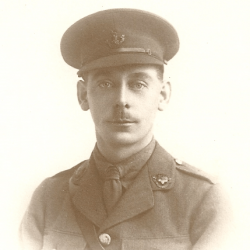
Many books have been written about the 3rd Battle of the Aisne (Chemin des Dames) and there is nothing new added here but this page will provide particular focus on what happened on the first day, May 27, 1918 to the 1/Sherwoods (8th Division) before 9am and to the 9th Loyal North Lancashire Regiment (25th Division) before 6pm.
Operation Bluecher-Yorck, which commenced on May 27, 1918 was the 3rd Operation of the German Spring Offensive (Kaiserschlacht). The German Spring Offensive was “the last of the ebb” and ultimately failed for a number of strategic reasons.
The Germans were ruthlessly well prepared while the Allies laboured under certain operational and political constraints. But tactical brilliance undermined by strategic blunders meant that the Germans won the battle but ultimately lost the war.
The 3rd Battle of the Aisne started with a 3 hour Artillery barrage of unprecedented ferocity and scale consisting of both High Explosive (HE) shells and poison gas. This was immediately followed by overwhelming numbers of elite, battle hardened German storm troops (Sturmtruppen) advancing en-masse still under cover of the early dawn light and thick mist. The German troops advanced rapidly, bypassing any pockets of strong resistance, leaving them to e mopped up by their secondary wave. British Company, Battalion and Brigade HQs were rapidly overrun the consequence of which being that no comprehensive official record exists since papers were unsurprisingly destroyed, lost or captured in the ensuing chaos.
Consequently, the narrative of what exactly happened, certainly before 9am on the 1st day, can only be pieced together from Brigade and Divisional war diary fragments and from individual accounts written much later. One of the best of these accounts is undoubtedly the one published in 1937 by Sidney Rogerson, in ‘The Last of the Ebb’, an excerpt of which was included in the 8th Division war diary. Capt. Rogerson served on the Staff of the 2nd West Yorks, (8th Division).
Pte. Arthur Slater 1/Sherwoods was right in the middle of all that pre-dawn chaos, captured in the Bois de la Miette; a small wood on the Miette stream, situated half-way between the 24th and 25th Infantry Brigade HQs, (the Miette’s course separating the two Brigade sections). Based upon the fact that all three of the 8th Division Brigade HQs were abandoned by 6am we can reasonably conclude that he was captured around about that time. It’s a miracle he was not killed.
2nd Lt. A. E. Downing with the 9th Loyal North Lancashires (9/LNLs) was not caught up in the initial onslaught as the 9/LNLs were in Divisional reserve at Muscourt. The Germans were already crossing the Aisne, at Pontavert (the bridge not being blown), by the time the first group of 9/LNLs were called forward to defend the Canal at Maizy (West of Pontavert). And the German advance troops were already more than a kilometer South of the Aisne by noon when the remainder of the 9/LNLs moved up to meet them. Lt. Downing’s story is wrapped up in the less chaotic tactical retreat that slowed the pace of the German advances, made possible through the re-ordering and the piecemeal reconstitution of smashed Brigades and Divisions that started to take place in the early afternoon of the 1st day, South of the Aisne.
It is remarkable that these two men who did not know each other and had never met would be caught up in the same battle, on the same day, just a few kilometers from each other. One killed in action; the other taken as a Prisoner of War. Eventually being related via marriage when Arthur Slater‘s son married Alfred Edward Downing‘s niece 36 years later.
GERMAN SPRING OFFENSIVE
In March 1918, the Germans launched the Spring Offensive (Kaiserschlacht). Aware that American troops would soon be arriving in Europe, the Germans saw this as their last chance to win the war. If they could overcome the Allied armies and reach Paris, victory might be possible. The German offensive was initially a great success. Striking at the Allied line’s weakest point, the Chemin des Dames, they burst their way through and made quick progress towards the Marne. However, the advance eventually stalled due to supply shortages and lack of reserves. This was to be the ‘last ebb’ of the German war effort.
- Operation Michael March 21, 1918
- Operation Georgette April 9, 1918
- Operation Blucher-Yorck May 27, 1918
Operation Blücher-Yorck was planned primarily by Erich Ludendorff, who was certain that success at the Aisne would lead the German armies to within striking distance of Paris. Ludendorff, who saw the British Expeditionary Force as the main threat, believed that this, in turn, would cause the Allies to move forces from Flanders to help defend the French capital, allowing the Germans to continue their Flanders offensive with greater ease. Thus, the 3rd battle of the Aisne was essentially a large diversionary attack.
Colonel Georg Bruchmüller:
Col. Bruchmüller commanded the German Artillery in Operation Blücher-Yorck. Bruchmüller developed and perfected a system of centralised command so that the batteries could fire, solely off map references, using a program which co-ordinated with movements on the battlefield instead of merely supporting limited troop movements. He devised an intense artillery bombardment which neutralised defences by disorientating or killing the majority of the defenders before the German advance went forward behind a creeping barrage. At the Aisne, the thousands of artillery pieces fired from their maps, in darkness, allowing the infantry to advance at first light into a battered and disoriented defence.
THE ALLIED SITUATION
The defense of the Aisne area was in the hands of General Denis Auguste Duchêne, commander of the French Sixth Army. In addition, four divisions of the British IX Corps, under Lieutenant-General Sir Alexander Hamilton-Gordon, held the Chemin des Dames Ridge; they had been posted there to rest and refit after surviving Operation Michael.
The Allies faced a number of challenges:
Despite British protests, Duchene insisted that the British defensive positions be North of the Aisne because he was unwilling to cede any ground to the Germans due to the heavy French losses incurred to win the ground during the Nivelle Offensive of 1917. The British would have preferred to place their Artillery South of the Aisne and defend in depth.
The positions of the Allied Artillery were well known to Germans because the French had been there a long time and the Germans had many months to accurately locate them.
British troops were tired and depleted. Young, barely trained recruits, with no battle experience, making up the numbers. They were there to rest, refit and properly assimilate the new recruits into their battalions before going back to the front lines.
British troops had been there less than a month and were getting familiar with their new surroundings and generally fixing things to their liking after the long rather leisurely French occupation.
The Allied forces were greatly outnumbered in Artillery and Men. 8 Allied Divisions faced 17 German Divisions and 4,000 guns.
EVENTS OF 27 MAY, 1918
The following narrative is excerpted from (and copyright of) the book 8th Division in War 1914 – 1918, by Lt. Colonel J.H. Boraston & Captain Cyril E.O. Bax which in turn acknowledges that most of the information supplied to the regimental historians for this account (below) came from Captain Sidney Rogerson of the 2nd West Yorkshire Regiment. The section on the Royal Engineers and the Bridges is excerpted from (and copyright of) the History of the Corps of Royal Engineers, Volume V, by Major-General H.L. Pritchard. Sub-headings and annotated maps have been inserted to aid readability and illustrate locations and timing of events.
Yet the feeling of silence persisted. Not a shell came from the enemy, and his quietness removed any lingering doubts as to his intentions.
How that evening dragged. The time crept slowly on towards zero hour till only a few minutes were left…. Suddenly two German Gas shells burst close at hand, punctual heralds of the storm. Within a second, a thousand guns roared out their Iron hurricane. The night was rent with sheets of flame. The earth shuddered under the avalanche of missiles… leapt skywards in dust and tumult. Ever above the din screamed the fierce crescendo of approaching shells, ear splitting crashes as they burst… all the time the dull thud, thud of detonations… drum fire. Inferno raged and whirled round the Bois des Buttes. The dug outs rocked… filled with the acrid fumes of cordite, the sickly sweet tang of gas. Timbers started, earth showered from the roof, men rushed for shelter, seizing kits, weapons, gas masks, message pads as they dived for safety. It was a descent into hell. Crowded with jostling, sweating humanity the dug outs reeked and to make matters worse Headquarters had no sooner got below than gas began to filter down.
Gas masks were hurriedly donned and anti-gas precautions taken- the entrance closed with saturated blankets, braziers lighted on the stairs. If gas could not enter, neither could air. As a fact both did in small quantities and the long night was spent forty feet underground, at the hottest time of the year, in stinking overcrowded holes, their entrances sealed up and charcoal braziers alight drying up the atmosphere – suffocation rendered more complete by the gas mask with clip on nostrils and gag in teeth.
It was one o’clock in the morning of the 27th May, punctual to the predicted time, that the German bombardment was loosed. The whole of IX Corps front and many back areas – railheads, ammunition dumps and the like – were drenched with gas shell. Outpost lines were assailed in addition by trench mortars of every calibre, and the Battle Zone received the terrible bombardment from artillery of all natures which has just been so graphically described. Our artillery positions were also violently attacked with gas shell and H.E. and had area shoots carried out upon them, with the result that by 6am most of our guns North of the river were out of action. A mist which rose into being with the opening of the bombardment, as though evoked at the will of the German Higher Command and in fact accentuated by the enemy’s gas and smoke shells, grew steadily thicker as the night proceeded and made the task of defence additionally difficult. It was indeed, almost uncanny how in this spring of 1918 the luck of the weather favoured the Germans in attack. On each preceding night spent on the new front the weather had been clear and when, for the third time, the troops of the division found their defence hampered by a dense blanket of fog, men and officers began firmly to believe that the enemy had discovered means to put down a mist whenever it was wanted.
The first Infantry attack, assisted by tanks which flattened out the wire, was delivered, it is probable, at about 4 o’clock in the morning, against the angle of the salient in our right sub-sector (25th Infantry Brigade). Owing to the dense mist and to the fact that nearly all units in the Outpost Zone were cut off to a man, it is difficult to reconstruct precisely the sequence of events. It is only at intervals that a clear message comes back out of the chaos and confusion which the fog necessarily produced. Even such a message only serves to emphasize the assistance which the lack of visibility and the exposed position of our troops in the salient gave to the enemy in his attack. Take for instance, the following pigeon message, timed at 5.15am, which was received at Divisional Headquarters at 6.05am: HQ 2nd R.Berks Regt, consisting of Lieut-Col Griffen, Capt Clare, RSM Wokins, Sergt Trinder, Corpl Dobson, Ptes Stone, Gregory, Slee, and QM surrounded. Germans threw bombs down dug outs and pressed on. Appeared to approach from right rear in considerable strength. No idea what has happened elsewhere. Holding out in hopes of relief.
Such hopes were alas in vain.
The attack swept forward, and although our troops resisted stubbornly for a time in the Battle Zone and caused severe losses to the enemy on this line, the defence was overwhelmed by weight of numbers. Brigade HQ had been early involved in the fighting, being practically surrounded before it was known that the front line had gone. It was near here that the brigade major, Captain B.C. Pascoe, M.C., Rifle Brigade, was killed while making a gallant stand. General Husey and what remained of his HQ staff fought their way out and moved back to Gernicourt to organise its defences. At 6.30am General Husey reported to Divisional HQ that he was holding the river line there with the remnants of his brigade. At 7.15am he further reported that all the bridges east of the junction of the Miette and Aisne had been blown up and that he was holding the high ground west of Gernicourt. Later in the morning General Husey, who had only taken command of the brigade front (vice General Coffin, promoted to Divisional Command) on the 7th May, was badly wounded and gassed, and he died a few days after in German hands.
Meanwhile the fortunes or misfortunes of the other two brigades remain to be considered. These two brigades do not appear to have been seriously attacked until about 5am. The front line battalion of the 24th Infantry Brigade (2nd Northamptonshire) was then gradually driven back to the Battle Zone. Tanks do not appear to have been used on this front, but as the light increased enemy aeroplanes were observed flying low over our forward system and firing into the trenches. Colonel Buckle, whose conduct and example had been an inspiration to his men, was killed outside his Battalion HQ, but his battalion fought on and in the Battle Zone in this sector the enemy’s advance was definitely checked. The position here was very strong and repeated attacks were beaten off both by the 2nd Northamptons and 1st Worcestershires.
The last message sent by Colonel Buckle to his front line companies a short time after the German bombardment started, is recorded in tribute to a very gallant officer, and as an example of the spirit in which the defence was made. It ran:
“All Platoon commanders will remain with their platoons and ensure that the trenches are manned immediately the bombardment lifts. Send short situation wire every half hour. No short bombardment can possibly cut our wire and if sentries are alert it cannot be cut by hand. If they try it, shoot the devils. C.G.Buckle, Lieut-Col”
This message was found pinned on the wall of the battalion HQ dug out by Colonel Buckle’s father, who visited the spot after the Armistice. He found his son’s grave close to the entrance, and on each side of the grave a German had been buried. Those who knew Colonel Buckle felt sure he would fight to a finish and never surrender.
The position here was, as has been said, so strong that our troops might well have held out indefinitely against any frontal assault, but the enemy was able to profit by his success on our right. At 5.45am large numbers of Germans were suddenly observed from the 24th Brigade H.Q. approaching along the line of the Miette Stream which they had crossed south of the Battle Zone. The main line of defence was taken by this movement in flank and rear and its defenders were cut and surrounded. Major Cartland, commanding the 1st Worcestershires, was killed in the trenches with his men and, at 6am, Brigade HQ was itself attacked from the rear. The staff captain to the brigade was taken prisoner, and General Haig, and his acting brigade Major (Capt. F.C. Wallace, M.C.) both of whom were suffering from gas, had great difficulty in getting clear. A few others, including the signalling officer, intelligence officer and some of brigade H.Q personnel, managed to fight their way back to la Pecherie bridge, the defence of which they organised under Captain Pratt, M.C., 1st Worcestershire. The Germans, however, were seen shortly afterwards to have worked round behind Capt. Pratt’s party and appear to have cut them off. Soon after 9 o’clock in the morning the collected remnants of this brigade, now numbering 3 officers and 68 other ranks only, were holding a trench on the north east side of Roucy.
The Bridges (Royal Engineers)
The 15th Field Company (Major E.C. Hillman) was in dug-outs on the Aisne Canal a short distance west of Gernicourt, with one section, under 2nd Lieutenant H.C. Garbutt, detached near Berry-au-Bac. All sections had parties told off for bridge demolitions. As soon as news of the impending attack had been received, orders were issued that the bridges were to be blown at the discretion of the field company commanders on the spot. Accordingly, when he received the warning order from the C.R.E. (Commander Royal Engineers) at 8 p.m. on the 26th, Major Hillman went along the canal to verify the readiness of all his bridge-demolition parties. He was at Berry-au-Bac when the German bombardment opened at 1 a.m., and returned at once to his headquarters to order immediate packing-up and readiness to move. He sent out Lieutenants E.H. Jacobs-Larkcom and C. Sutton with written orders to blow their bridges as soon as it became evident to them that the enemy was advancing, and that the blowing of the bridges was necessary to prevent him from crossing the river. The canal bridges were to be blown after the river bridges. Shortly after this, all telephonic communications was cut, and no further instructions were received from the C.R.E., but at about 4:30 a.m., Major Hillman was handed a message from the 25th Brigade stating that the enemy had penetrated the right flank of the Rifle Brigade. Stragglers and wounded coming along the canal bank reported that the Germans were advancing rapidly. At 6 a.m., 2nd Lieutenant Strong was sent out to his bridges. At 6:15 a.m. 2nd Lieutenant Garbutt came in with his section and reported that he had blown all his six bridges at Berry-au-Bac, and that the enemy was being prevented from working along the canal by some gunners. At 7 a.m., Lieutenant Jacobs-Larkcom returned to company headquarters, wounded in the face, and was evacuated. Major Hillman, who had by now collected a number of stragglers and three infantry officers, disposed of his little force for the defence of the canal bank.
At 10 a.m., he was visited by Brigadier-General R.H. Husey, commanding the 25th Brigade, and ordered to take his men back across the canal and endeavour to hold the front edge of the Bois de Gernicourt. In the village itself were the 22nd D.L.I. (Durham Light Infantry – Pioneers) and some of the 490th Field Company. At 11 a.m., Major Hillman received word that the Germans were well across the river at Pontavert and were working round behind the Bois de Gernicourt. He was becoming more and more isolated, and there was a gap of 1,000 yards on his right between him and the East Lancashire Regiment, who were south-west of the village of Gernicourt. About midday, when it became obvious that the Germans were in the wood, he sent Captain A.D. Black, of the 490th Field Company, with twenty-five sappers, southwards to do what he could to prevent the enemy coming