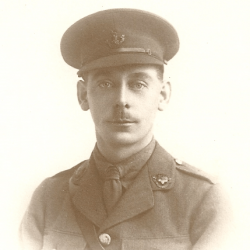
Pte. Sydney Caine

Sydney Caine was born on January 24, 1893 in Ashton-under-Lyne. In 1911 he was a 16 years old Grocer’s Assistant living at 48 Cranbrook St, Ashton with his parents and his three younger brothers: Arthur Edward Caine, George Rayner Caine and Leonard Caine.

In April 1913, his brother Arthur Edward Caine went to Victoria, British Columbia, to stay with their half-brother Percy Caine who had emigrated there in 1901. Not long after the outbreak of war, Arthur returned to England arriving in Liverpool on January 24, 1915.

9th Manchesters

Syd Caine joined the 9th Battalion, Manchester Regiment on October 17, 1914 the same day as his best friend Arthur Slater. His service number was 2680. They underwent basic training with the 2/9th Manchesters at Southport and on July 5, 1915 sailed to Gallipoli arriving on the 23rd. They fought in the Battle of Krithia Vineyard in early August and endured the brutal front line trench warfare and harsh conditions that followed.

On September 22nd Syd was admitted to the Number 11 Casualty Clearing Station with jaundice and evacuated from the peninsula on the Hospital Ship Ausonia, arriving in Malta on September 28. He rejoined the Base Depot at Alexandria on December 7th and was classified fit for active service (Class A). He was then shipped to Mudros where he rejoined the Battalion on January 3, 1916 after they had left Gallipoli for good. The 9th Battalion, Manchester Regiment sailed from Mudros to Egypt in late January 1916 where Syd spent the next year with them defending the Suez Canal from attack by the Turks.

Royal Navy

Back home in Ashton, Syd’s brother George had enlisted with the Royal Navy on September 16, 1915 and his brother Arthur followed him on January 4, 1916. Both of them underwent basic training at the Naval Barracks at Devonport before being deployed to their respective ships; George to HMS Collingwood on December 4, 1915 and Arthur to HMS Indefatigable on  April 9, 1916. Back in Canada, their half-brother Percy Caine joined the 103rd Battalion, Canadian Expeditionary Force on December 11, 1915 and deployed to England in June 1916 where he served in a support role at Seaford and Hastings until returning to Canada in 1918.

On May 31, 1916 Arthur Edward Caine’s ship, HMS Indefatigable, was sunk with the loss of all but 3 hands at the Battle of Jutland. HMS Collingwood was also there and George must have witnessed his brother’s ship being hit, exploding and sinking. Their parents received the following message from the Admiralty:

“I regret to have to inform you that Arthur Edward Caine, rated ordinary seaman, is believed to have been on board H.M.S. Indefatigable when that vessel was sunk in action. Under these circumstances it is feared that in the absence of any evidence to the contrary he must be regarded as having lost his life.”

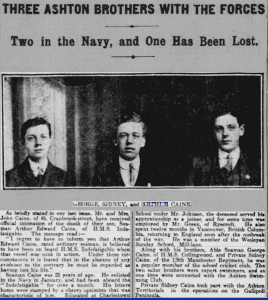
The Saturday June 17, 1916 edition of the Ashton Reporter carried the following tribute the Caine brothers’ military service:

George, Sydney and Arthur Caine
Ashton Reporter June 17, 1916: George, Sydney and Arthur Caine

Egypt 1916

Back in Egypt, Syd served with the 9th Battalion, Manchester Regiment Scouts along with his old friend Arthur Slater.

Regimental Scouts Bir el Abd October 1916

In November 1916 Syd injured his left knee and was admitted to 31st General Hospital in Port Said. Syd spent two months in hospital rejoining the 42nd Division Base Depot in Alexandria on January 8, 1917.

Royal Engineers

Shortly after rejoining the Division Syd was sent to Signals School for a month subsequently joining the Signals Company. Meanwhile the 42nd Division sailed for France on March 4, 1917 leaving Syd in Egypt.

A month later he was admitted to the Citadel Hospital in Cairo with a broken collar bone and was discharged 4 weeks later on April 11th. He spent the next 4 months at Serapeum, Cairo and on August 17, 1917 was officially transferred from the 1/9th Manchesters to the 3rd East Lancs Royal Engineers, Territorial Force with service number 443872. He remained with them in Egypt for the duration of the war sailing back from Port Said on March 18, 1919 aboard the HMT Magdelena.

He was discharged from the Army on April 9, 1919 his papers noting that he was sober, intelligent, reliable and industrious. Back in Ashton-under-Lyne he became a civil servant and is said to have helped his old friend Arthur Slater obtain a job at the Labour Exchange.

Sid Caine and Arthur Slater in 1947
« of 4 »

He married Eleanor (Nellie) Knowles, a felt hat trimmer, in October 1921 and they moved to 23 Clarendon St, Dukinfield.

Sid & Nellie Caine1926

Sydney Caine died on March 15, 1968, two months after his best friend Arthur Slater. He was 75 years old.  Syd’s wife, Nellie, lived to be 94 years old.

Acknowledgements:

Special thanks to Gillian Aldred (née Caine) who provided the Ashton Reporter newspaper article and highlighted the Caine brothers’ Naval Service.


1st Battalion Sherwood Foresters

August 1914:
The 1/Sherwoods were in Bombay, India when war broke out. They quickly returned to England, landing at Plymouth on 2 October, 1914. They immediately moved to Hursley Park and came under orders of the 24th Infantry Brigade of the 8th Division.

November 1914:
On the 5 November, 1914 they landed at Le Havre and from this point forward they fought on the Western Front in the 24th Infantry Brigade of the 8th Division.

January 1918:
CANAL BANK, YPRES
Order of Battle of the 8th Division week ending January 5, 1918:

Unit Officers O.R.s
23rd Infantry Brigade
2nd Devons 43 916
2nd West Yorks 34 656
2ns Scottish Rifles 34 887
2nd Middlesex 39 705
23rd Machine Gun Co 10 182
TOTAL 160 3,346
24th Infantry Brigade
1st Worcesters 33 763
2nd East Lancs 38 550
1st Sherwoods 32 633
2nd Northants 39 879
24th Machine Gun Co 9 180
TOTAL 151 3,005
25th Infantry Brigade
2nd Lincolns 26 724
2nd Royal Berks 37 587
1st Irish Rifles 36 679
2nd Rifle Brigade 32 644
25th Machine Gun Co 10 182
TOTAL 141 2,816
218th Bn MG Company 9 180
22nd Durham LI (Pioneers) 35 782
GRAND TOTAL 496 10,129

Drafts for the 1/Sherwoods arrived throughout the month totaling 9 Officers and 152 Other Ranks.

February 1918:

STEENVORDE, FRANCE.

Drafts for the 1/Sherwoods arrived throughout the month totaling 1 Officers and 108 Other Ranks.

March 1918:

In February 1918 the Division was re-organized to support 3 Battalions per Infantry Brigade and the Brigade Machine Gun Companies were consolidated into a separate Machine Gun Battalion made up of the three Brigade MG Companies plus the 218th Battalion Machine Gun Company.

Unit Officers O.R.s
23rd Infantry Brigade
2nd Devons 41 937
2nd West Yorks 35 930
2nd Middlesex 50 934
TOTAL 126 2,801
24th Infantry Brigade
1st Worcesters 42 847
1st Sherwoods 41 930
2nd Northants 34 985
TOTAL 117 2,762
25th Infantry Brigade
2nd East Lancs 43 889
2nd Royal Berks 59 840
2nd Rifle Brigade 36 818
TOTAL 138 2,547
22nd Durham LI (Pioneers) 49 906
8th Div MG Btn 45 868
GRAND TOTAL 475 9,884

During the first half of the month, drafts for the 1/Sherwoods arrived daily totaling 1 Officers and 62 Other Ranks.

First Battle of the Somme, 1918

From March 22 to April 4th the 1/Sherwoods took part in what was to become known as the First Battle of the Somme, 1918.  Early in the morning of March 21, 1918 the Germans attacked the allied lines during the opening of the Spring Offensive. As the Germans pushed forward the 8th Division was moved from Flanders to the Somme to do what it could to stem the tide. The 1/Sherwoods dug in on the West bank of the Somme and defended the bridge at St Christ on the evening of March 23rd. The next few days saw the 1/Sherwoods engaged in dogged resistance, ordered withdrawal and then counter-attack. By the end of the engagement the 8th Division had fulfilled its duties but had suffered significant casualties.

Unit Officers Other Ranks
K W M Total K W M Total
23rd Infantry HQ 0 0 1 1 3 3 1 7
2nd Devons 3 11 2 16 29 215 63 307
2nd West Yorks 6 12 2 20 30 182 377 589
2nd Middlesex 2 9 13 24 16 96 354 466
24th Infantry HQ 0 1 0 1 0 0 0 0
1st Worcesters 2 16 1 19 24 180 200 404
1st Sherwoods 3 7 3 13 26 89 264 379
2nd Northants 5 9 4 18 27 122 159 308
25th Infantry HQ 0 0 0 0 0 0 0 0
2nd East Lancs 2 19 2 23 35 223 211 469
2nd Royal Berks 3 21 4 28 30 169 102 301
2nd Rifle Brigade 6 11 3 20 32 105 300 437
22nd DLI (Pioneers) 4 12 7 23 29 149 291 469
8th Div MG Btn 4 8 4 16 22 120 178 320
Royal Artillery 2 11 0 13 10 62 25 97
Royal Engineers 1 5 6 12 8 49 74 131
RAMC 0 1 2 3 0 9 0 9
Totals 43 153 54 250 321 1,773 2,599 4,693

April 1918:

During the first 3 weeks of April the 1/Sherwoods were out of the front line, resting and re-organizing their companies due to the heavy losses suffered in March.  During the early part of the month a significant number of new drafts were received.

Date Officers O.R.s Total
April 4, 1918 0 439 439
April 5, 1918 0 2 2
April 9, 1918 0 141 141
April 11, 1918 3 0 3
Monthly Totals 3 582 585

More than 50% of the Battalion’s fighting strength was replaced by these men during a two week period. The logistics and organizational disruption of such a significant change in personnel in a front line infantry unit must have been overwhelming.

Drafts of April 4, 1918

At least 250 of the men who made up the Draft of April 4th came from the Manchester Regiments, an additional 100 from the Lancashire Fusiliers (who were subsequently assigned Service Numbers 108816 – 108914).

During the Brigade and Divisional re-organizations that took place in February and March 1918 the 2/10th Manchester Regiment was disbanded in France and the 2/9th Manchester Regiment was absorbed into the 1/9th Manchester Regiment and ceased to exist.  In April, the 1/9th Manchester Regiment and the 2/5th Manchester Regiment were reduced to a cadre. The surplus men from these regiments found themselves at the Infantry Base Depots in Etaples at the end of March 1918 and were re-assigned to other regiments as needs arose.

Approximately 40 men previously serving in a variety of Manchester Regiments joined the 1/Sherwoods from the Manchester Infantry Base Depot in Etaples. These men were given Service Numbers 108926 – 108965.

Approximately 35 men previously serving mainly in the 1/9th Manchester Regiment and 1/10th Manchester Regiments joined the 1/Sherwoods from the Manchester Infantry Base Depot in Etaples, many shipping out from the UK on March 31, 1918. These men were given Service Numbers 205420 – 205455. Included in these men was Arthur Slater.

But perhaps the most interesting group was approximately 155 young men who were 18-19 years old and were raw recruits recently drafted into the Army through the Military Service Act. These men had no prior military experience.  Drafted into the Army Reserve, for the duration of the war, approximately 3 months before their 18th birthday and assigned to one of the training battalions (mainly the 71st  & 67th Training Reserve Battalions) with a reserve service number and based at Ripon (71st) or at the Altcar Training Camp in Hightown, Merseyside (67th). They were subsequently posted to the 5th (Reserve) Battalion Manchester Regiment on November 27, 1917, moved to Scarborough and assigned a “proper” 5 digit Manchester Regiment service number (59*** or 60***). They then proceeded to Folkestone on March 30, 1918 and embarked for Boulogne arriving March 31, 1918. Assigned to the Manchester Infantry Base Depot (MIBD) at Etaples, where on April 4, 1918 they were transferred  to the 1st Battalion Notts and Derby Regiment (1/Sherwoods), and assigned a new six digit service numbers in the range 108979 – 109155.

Drafts of April 9th

It appears that the vast majority (and possibly the entirety) of the draft of men who were taken on the strength of the Battalion on April 9, 1918 were another batch of raw recruits, with no prior military experience, mostly from the Nottinghamshire and Staffordshire areas.  Drafted into the Army Reserve, for the duration of the war, approximately 3 months before their 18th birthday and assigned into 7th Reserve Battalion Notts and Derby Regiment, based in Ripon where they underwent basic training. They embarked at Folkestone and Disembarked at Boulogne on 3 April, 1918. Assigned to No 4 Infantry Section, GHQ 3rd Echelon BEF and transferred to 1st Battalion Notts and Derby Regiment on 9 April, 1918. Assigned a new five digit service number in the range 95807 – 95970.

This means that in the space of less than a week the 1/Sherwoods added more than 300 raw recruits who were  18 (or in some cases just 19) years old; fully 1/3 of Battalion strength.

The Battalion was now made up of several different collections of men:

  1. Experienced men of the Notts and Derby Regiments, some of who had served with the 1/Sherwoods for the duration of the war.
  2. Raw recruits, 18-19 years old and fresh out of basic training, who were Notts and Derby men.
  3. Experienced men formerly of the Lancashire Fusiliers.
  4. Experienced men formerly of the Manchester Regiments.
  5. Raw recruits, 18-19 years old and fresh out of basic training, who were Manchester Regiment men.

Second Battle of VILLERS-BRETONNEUX

In April, the 1/Sherwoods took part in what was to become known as the Second Battle of VILLERS-BRETONNEUX. The Battalion moved on April 12th eventually going into the front line on April 19th, at VILLERS-BRETONNEUX. They were relieved on the evening of the 23rd and marched back to reserve billets in BLANGY TRONVILLE. At 3:45am on the 24th the Germans began a frontal assault, under cover of mist and smoke, and had successfully penetrated the Allied lines at VILLERS-BRETONNEUX by 9:30am. The 1/Sherwoods were immediately put under the temporary command of the 23rd Infantry Brigade and were ordered to launch a counter-offensive attack at 10am.  Fighting continued until the night of the 27th when the 1/Sherwoods were relieved but the counter-offensive was successful and VILLERS-BRETONNEUX was recaptured with the Germans driven from all their positions. However the toll on the Battalion was heavy and 234 men were officially listed as Killed, Wounded or Missing. The Battalion had been severely depleted once again.

Unit Officers Other Ranks Grand
K W M Tot K W M Tot Total
23rd Infantry HQ 0 0 0 0 0 1 0 1 1
2nd Devons 3 6 1 10 49 184 93 326 336
2nd West Yorks 1 5 10 16 18 162 226 406 422
2nd Middlesex 2 2 9 13 6 98 435 539 552
23rd LTM Bty 0 0 0 0 1 2 13 16 16
1st Worcesters 3 8 0 11 20 106 0 126 137
1st Sherwoods 3 4 0 7 36 176 15 227 234
2nd Northants 4 6 0 10 15 251 19 285 295
24th LTM Bty 0 1 0 1 0 4 0 4 5
2nd East Lancs 3 8 2 13 31 153 85 269 282
2nd Royal Berks 3 7 0 10 55 185 10 250 260
2nd Rifle Brigade 1 3 10 14 15 68 297 380 394
25th LTM Bty 0 0 0 0 1 7 5 13 13
22nd DLI (Pioneers) 2 4 0 6 59 186 8 253 259
8th Div MG Btn 1 0 5 6 12 78 91 181 187
Royal Artillery 1 11 0 12 7 85 0 92 104
Royal Engineers 1 1 0 2 1 39 0 40 42
RAMC 0 1 1 2 1 10 1 12 14

A total of 133 Officers and 3,420 Other Ranks killed, wounded or missing; 3,553 in all.

And of those casualties the following 13 young men, formerly of the 5th Reserve Manchester Regiment – posted to their first fighting unit only 3 weeks earlier – lost their lives during the actions at VILLERS-BRETONNEUX.

Rank Service Number Forename MI Surname Age DoD
Pte 109027 SAMUEL EGERTON 18 24-Apr
Pte 109062 FRANK POWELL 18 24-Apr
Pte 109076 ALEXANDER SMITH 18 24-Apr
Pte 109077 GEORGE C. SUMERFIELD 18 24-Apr
Pte 109098 THOMAS HOWARD 18 24-Apr
Pte 109112 JOHN DEWHURST 18 24-Apr
Pte 109156 GEORGE H. BENNETT 18 24-Apr
Pte 108985 WILLIAM L. E. LEWIS 18 25-Apr
Pte 108986 ROBERT MACARTHUR 25-Apr
Pte 108995 JOHN WRIGHT 18 25-Apr
Pte 109037 FRANK HICKLIN 19 25-Apr
Pte 109059 MORNINGTON PALEY 25-Apr
Pte 108982 DOUGLAS G. JACKSON 19 27-Apr

May 1918:

In the early hours of May 27, 1918 the Germans launched a ferocious artillery barrage with signaled the start of the 3rd Battle of the Aisne. By the time it was over 698 Officers and men of the 1/Sherwoods were officially listed as Killed, Wounded or Missing.

The list of Officers present that day is as follows:

Rank Forename Middle Middle Surname Fate
Lt. Col. JOHN D MITCHELL
Lt. Col. ROBERT FRANK MOORE KiA
Maj. JOHN EDWARDS
Capt. ERIC BOSWORTH GREENSMITH PoW
Capt. CLARENCE HARRISON PoW
Capt. JOHN FERGUSON MENZIES PoW
Capt. REGINALD GUY PEARSE
Capt. WILLIAM WESTON
Lt. GEORGE DUNCAN McINTYRE ABBOTTS WiA
Lt. LEONARD LESLIE DAWSON KiA
Lt. JOHN GORHAM FIELD
Lt. CECIL WILLIE LAWS KiA
Lt. ALEXANDER STRAW MiA
Lt. GUY LUNTLEY TUTIN
Lt. JOHN EDWARD MILLS WALKER PoW
2/Lt.  CHRISTOPHER AMBLER WiA
2/Lt. WILLIAM EDWARD BROWN PoW
2/Lt. CHARLES ERNEST CUMBERLAND WiA
2/Lt. WILLIAM JOHN RUSSELL ELLIOTT WiA
2/Lt. HARRY GREAVES
2/Lt. WILLIAM LESLIE GREEN WiA
2/Lt. GEORGE AUGUSTUS HANCOCK
2/Lt. ARTHUR FRANCIS HEATH WiA
2/Lt. FREDERICK RICHARD HINDERLICH WiA
2/Lt. THOMAS ERNEST INMAN PoW
2/Lt. ALFRED OLIVER JACKSON
2/Lt. FREDERICK GEORGE KYLE WiA
2/Lt. ALFRED MILLWARD WiA
2/Lt. ARTHUR NEILD PoW
2/Lt. WILLIAM NOBLE WiA
2/Lt. FITZ DONALD SEVERN PoW
2/Lt. DENNIS MOULTON START PoW
2/Lt. GEORGE WALTER WEBB PoW

The following table lists the 67 young men formerly of the 5th Reserve Manchester regiment who were either killed or captured on May 27, 1918.

Rank  Service No.  Forename  Middle  Surname Age Fate
Pte 108974 James Beesley PoW
Pte 108979 Thomas John Pellow Howes 19 KiA
Cpl 108980 Harry Humphreys PoW
Pte 108987 John Noone PoW
Pte 108989 Ronald John Siddle PoW
Pte 108993 Archibald Campbell Tyre 18 KiA
Pte 109004 Ignatius Harring PoW
Pte 109006 Francis Edward Nutter 18 KiA
Pte 109007 William Ashton 19 KiA
Pte 109008 Stanley Harold Atherton 19 KiA
Pte 109011 Joseph William Barratt 19 KiA
Pte 109012 George William Bishton PoW
Pte 109015 Henry Burns KiA
Pte 109020 Harold Brown 19 KiA
Pte 109023 Allen Diver 19 KiA
Pte 109025 Albert Edward Dodgson PoW
Pte 109028 William Evans 18 KiA
Pte 109029 George William Ernest PoW
Pte 109034 Peter Henry Halliwell PoW
Pte 109035 Joseph Hansbury PoW
Pte 109036 Samuel Hacking PoW
Pte 109038 John Grafton Hoskins PoW
Pte 109039 Henry Hopkins PoW
Pte 109041 Horace Jones PoW
Pte 109042 Sydney Jones PoW
Pte 109046 Alfred Lee 19 KiA
Pte 109050 John Mayor PoW
Pte 109051 Francis McQuade PoW
Pte 109052 Ernest McAuley PoW
Pte 109053 Alfred Hubert Madeley PoW
Pte 109054 John Mills 19 PoW
Pte 109056 James Nelson 19 KiA
Pte 109057 John Norris PoW
Pte 109061 Norman Pilkington PoW
Pte 109063 William Coventry Reid 19 PoW*
Pte 109066 William Baden Powell Richards 19 PoW
Pte 109073 John Steele 19 KiA
Pte 109075 James Henry Shepherd PoW
Pte 109083 Claude Llewellyn John Wroe PoW
Pte 109084 Harry Williamson KiA
L/Cpl 109085 Arthur Wilson PoW
Pte 109089 John Cleave Riley 19 KiA
Pte 109097 Thomas Henry Cashen PoW
Pte 109102 Herbert Austin 19 KiA
Pte 109103 Alexander Allan 19 PoW
Pte 109105 George Wain Baird 19 KiA
Pte 109108 Charles Baker 19 KiA
Pte 109111 Edward Newton Clarkson 19 PoW
Pte 109113 John Oxford 18 KiA
Pte 109114 Herbert Owen Parry 18 KiA
Pte 109115 William Pickard PoW
Pte 109116 Joseph Powell 19 KiA
Pte 109117 Joseph Riley 19 PoW
Pte 109118 Francis Joseph Rogers 19 KiA
Pte 109121 Alfred Shackley PoW
Pte 109122 James Sanderson PoW
Pte 109124 Fred Syer 19 KiA
Pte 109125 George William Taylor PoW
Pte 109126 George Walters PoW
Pte 109130 Thomas H Fenney PoW
Pte 109133 Albert Harris 19 PoW
Pte 109134 William J. Hawkins 19 KiA
Pte 109136 Alfred Haw PoW
Pte 109137 Herman Isherwood PoW
Pte 109139 George Edward King 19 KiA
Pte 109147 Albert Woolley 18 KiA
L/Cpl 109148 Albert Worrall PoW
Pte 109155 Joseph Lockley 19 KiA

*William Coventry Reid was captured on May 27, 1918 and died of wounds on May 29,1918.

The following table lists the 15 young men formerly of the 7th Reserve Sherwood Foresters who were either Killed or Captured on May 27, 1918.

Rank Co Service No Forename Middle  Surname Age Fate
Pte 95807 Clarence Stephen Cox 18 KiA
Pte B 95877 Jacob Attwood 18 PoW
Pte 95887 James Reginald Batchelor 18 KiA
Pte 95897 John Charles Hubbard PoW
Pte 95899 William Ernest Hames 18 KiA
Pte A 95901 Bertie Johnson PoW
Pte D 95913 Reginald Sharpe PoW
L/Cpl 95924 Cris Burrows Cotton 18 KiA
Pte 95925 Rowland Cheshire 18 KiA
Pte D 95932 David Frederick Fisher 18 PoW
Pte 95941 Charles Henry Hughes 18 PoW*
Pte D 95955 Linford D Russell PoW
Pte A 95962 Francis Harold Benjamin Sturgess 18 PoW
Pte D 95967 Leonard Walker PoW
Pte 95970 Gilbert Walter Watson 18 KiA

* Charles Henry Hughes was captured on May 27, 1918 and subsequently died of wounds received on May 29, 1918.

The full Divisional Casualty numbers are simply staggering:

Unit Officers Other Ranks Grand
K W M Total K/W/M Total Total
23rd Infantry HQ 0 1 0 1 0 0 1
2nd Devons 1 4 24 29 552 552 581
2nd West Yorks 1 6 15 22 555 555 577
2nd Middlesex 1 3 22 26 578 578 604
23rd LTM Bty 0 0 0 0 27 27 27
24th Infantry HQ 0 0 1 1 0 0 1
1st Worcesters 3 11 15 29 589 589 618
1st Sherwoods 1 12 10 23 675 675 698
2nd Northants 1 5 18 24 629 620 644
24th LTM Bty 0 0 3 3 46 46 49
25th Infantry HQ 0 0 2 2 0 0 2
2nd East Lancs 0 10 15 25 560 560 585
2nd Royal Berks 2 2 20 24 683 683 707
2nd Rifle Brigade 2 9 17 28 744 744 772
25th LTM Bty 0 0 1 1 22 22 23
22nd Durham LI (Pioneers) 1 14 4 19 494 494 513
8th Bn MG Company 2 4 18 24 382 382 406
Royal Artillery 1 3 36 40 370 370 410
Royal Engineers 3 7 6 16 323 323 339
RAMC 0 1 20 21 248 248 269
Div Train ASC 0 3 0 3 25 25 28
Mobile Vet Sect 0 1 0 1 3 3 4
A.C.D. 0 0 4 4 0 0 4
Totals 19 96 251 366 7,505 7,496 7,862

The extent of the casualties is also evident from the weekly report of Divisional Fighting Strength reported at the end of the first full week of June as compared to that of January or March.

June 8th
Unit Officers O.R.s
23rd Infantry Brigade
2nd Devons 14 315
2nd West Yorks 13 221
2nd Middlesex 8 257
TOTAL 35 793
24th Infantry Brigade
1st Worcesters 9 243
1st Sherwoods 15 252
2nd Northants 9 274
TOTAL 33 769
25th Infantry Brigade
2nd East Lancs 13 301
2nd Royal Berks 18 277
2nd Rifle Brigade 14 270
TOTAL 45 848
22nd Durham LI (Pioneers) 19 460
8th Div MG Btn 24 501
GRAND TOTAL 156 3,371

SMS Wolf

SMS Wolf
Image courtesy of Australian War Memorial, collection ID P05338.173

By late 1916 the German battleships were tied up in port by the Royal Navy’s Grand Fleet and the only avenue for striking at Allied merchant shipping was through the U-boat fleet and surface raiders. Wolf was a merchant ship fitted with seven hidden 150mm guns, four torpedo tubes, 465 mines, and a reconnaissance seaplane (“Wölfchen”).

SMS Wolf Seaplane ("Wölfchen")
Image courtesy of Australian War Memorial, collection ID P05338.110

Her major task was to lay mines off Allied ports in the Indian Ocean and act as an independent marauder. The Wolf was relatively slow, with a top speed of only 11 knots but her bunkers could hold 8,000 tons of coal, giving her a huge cruising range of 32,000 nautical miles at eight knots. And those bunkers were regularly replenished over the course of her voyage from the supplies of the merchant steam ships that she captured.

Loading Mines onto SMS Wolf in Kiel
Image courtesy of Australian War Memorial, collection ID P05338.004.

SMS Wolf mined, captured and sunk allied shipping during a round trip voyage from Germany lasting from November 30, 1916 to February 24, 1918. After a year at sea, accompanied by the captured Spanish steamer Igotz Mendi, she headed back to Germany. The Igotz Mendi ran aground off Skagen, Denmark and was seized by the Danish military. Wolf reached Kiel, Germany on February 24, 1918 after a voyage of 100,000 km over 1 year, 2 months, and 25 days.

SMS Wolf Route Map

For the first 3 months, the Wolf concentrated on laying mine fields around South Africa, Ceylon and India. After laying mines along the entrance routes to Bombay the Wolf started to focus on acting as a surface raider. After a few months of raiding, the Wolf arrived off the coast of New Zealand and laid mine fields off New Zealand and in the Tasman Sea before resuming its raiding activities on the way to Singapore, where it laid its remaining mines. From there, the Wolf started on the long voyage home taking shipping prizes as they became available.

South Africa

Mines were first laid of the coast of South Africa in January 1917.

Laying Mines off the Coast of Africa 16-Jan-1917
« of 2 »

The following ships, with a combined gross tonnage of 21,384, were struck by mines off the Cape of Good Hope and sank:

Ship Flag Gross Tonnage Date
Matheran British 7,654 26-Jan-17
Cilicia British 3,750 12-Feb-17
C. de Eizaguirre Spanish 4,376 26-May-17
City of Athens British 5,604 10-Aug-17

The following ships, with a combined gross tonnage of 16,244, were struck by mines off Cape Agulhas (the geographic southern tip of the African continent) and were damaged but did not sink:

Ship Flag Gross Tonnage Date
Tyndareus* British 11,000 06-Feb-17
Bhamo British 5,244 26-Aug-17

*The Tyndareus struck a mine about 10 miles (16 km) off Cape Agulhas. The explosion tore a large hole in the forward part of her hull and she began to sink by the head. On board were 30 officers and 1,000 men of the 25th (Garrison Service) Battalion, The Middlesex Regiment, who were bound for Hong Kong.

Despite rough seas, all the troops were successfully transferred to the SS Eumaeus and the hospital ship HMHS Oxfordshire, which had responded to Tyndareus’s SOS signals. A British cruiser, HMS Hyacinth, arrived from Simonstown accompanied by a tug to assist the stricken troopship. The captain of Hyacinth ordered that Tyndareus be beached, as it was a hazard to shipping, but Captain Flynn ignored the order and was able to pilot the sinking ship safely into Simonstown, where she was repaired.

Some accounts of the SMS Wolf appear to characterize SS Tyndareus as a “war ship” since it was acting as a Troop Transport rather than a pure merchant ship.

India and Ceylon

After laying mines off the coast of South Africa the SMS Wolf steamed to Colombo laying more mines off the Port of Colombo and the Southern tip of India. From there mines were laid along all the major access routes to Bombay.

SMS Wolf Mine Laying off Colombo 15-Feb-1917
« of 2 »
Launching a Sea Mine from the SMS Wolf
Image courtesy of Australian War Memorial, collection ID P05338.010.
Mines Laid on the Approaches to Bombay Harbour. February 1917.

The following ships, with a combined gross tonnage of 36,711, were struck by mines off the coast of Bombay, British India and either sank or were so damaged that they had to be scrapped.

Ship Flag Gross Tonnage Date
Worcestershire British 7,175 17-Feb-17
Perseus British 6,728 21-Feb-17
Unkai Maru No. 7** Japanese 2,143 16-Jun-17
Mongolia British 9,505 24-Jun-17
Okhla British 5,288 29-Jul-17
Croxteth Hall British 5,872 17-Nov-17

** The Unkai Maru No 7 struck a mine from the SMS Wolf but photographic evidence indicates that it did not immediately sink and managed to make it into the Port of Bombay.

Unkai Maru View from Aft

The mines laid by SMS Wolf did not always stay in the place they were laid and several of them came ashore over the following months.

Mine being examined
« of 4 »

The following ship with a gross tonnage of 9,373 was damaged by a mine but managed to make it into the port of Bombay.

Ship Flag Gross Tonnage Date
City of Exeter British 9,373 11-Jun-17

The City of Exeter, a passenger ship, struck a mine in the Indian Ocean, about 400 m. from Bombay. Number 1 hold filled at once, and the master gave orders for the passengers and crew to leave the ship. Then the master and chief engineer returned and, at grave risk, made a thorough examination of the ship. They decided that, with the exercise of the greatest care, the crippled vessel could reach Bombay under her own steam. The passengers re-embarked and the ship safely arrived in port.

New Zealand

The SMS Wolf laid mines around the coast of New Zealand in June 1917.

SMS Wolf Mine Laying in the Cook Strait June-1917
« of 2 »

The following ships, with a combined gross tonnage of 8,322 tons, struck mines laid by SMS Wolf and sank off the coast of New Zealand (off Cape Farewell and in the Cook Strait, respectively).

Ship Flag Gross Tonnage Date  
Wimmera British 3,622 26-Jun-17  
Port Kembla British 4,700 17-Sep-17  

Australia (Tasman Sea)

In July 1917, the SMS Wolf laid mines in the Tasman Sea which quickly sank the following ship.

SMS Wolf Maine Laying off the Coast of Australia July-1917
Ship Flag Gross Tonnage Date
Cumberland British 9,471 06-Jul-17

Singapore

After laying mines in the Tasman Sea the SMS Wolf meandered her way to Singapore eventually laying mines there in September 1917. No allied merchant ships were reported damaged or sunk by these mines.

Mines Laid around Singapore Sept 1917

Aden

Back in February, after laying the mine field, at Bombay on the 19th February, Captain Nerger began seeking out enemy shipping.

SMS Wolf Mine Laying Route Bombay-Colombo Feb-1917

With great irony, the first vessel encountered was the SS Turritella, a sister ship to Wolf, (previously called the Gutenfels), captured by the British at the beginning of the war, at Port Said, and subsequently renamed and sold to the Anglo-Saxon Oil Company.

On February 27, 1917 the Turritella was re-captured off Colombo. The ship was renamed Iltis, after a ship in which Captain Nerger had served in China in 1900. A prize crew was placed on board along with 25 mines and a 12 pounder gun. She was ordered to place her mines around the port of Aden.

Turritella
Image courtesy of Australian War Memorial, collection ID P05338.043.

Port bow view of the 5,528 ton British freighter, Turritella, alongside the SMS Wolf. Crew members line the railing around the bow of the Turretella, which has just been captured.

On March 5th, 1917, while laying a minefield in the Gulf of Aden, she was spotted and chased by the British warships HMS Odin and HMS Fox. The crew, however, managed to scuttle her to avoid her changing hands for the third time in the war.

Two ships were damaged by the mines laid by Iltis but neither one sunk or was damaged beyond repair:

Ship Flag Gross Tonnage Date
Danubian British 5,064 20-Mar-17
Hong Moh British 3,910 05-Jan-18

Surface Raider

From February 1917 onward, the SMS Wolf was primarily engaged as a surface raider. In all, 14 ships with a combined gross tonnage of 38,391 tons were captured by the SMS Wolf over the following months.

Ship Flag Grt Captured Sunk
Turritella British 5,528 27-Feb-17 15-Mar-17
Jumna British 4,152 01-Mar-17 03-Mar-17
Wordsworth British 3,509 11-Mar-17 18-Mar-17
Dee British 1,169 30-Mar-17 30-Mar-17
Wairuna British 3,947 02-Jun-17 17-Jun-17
Winslow USA 567 16-Jun-17 22-Jun-17
Beluga USA 507 09-Jul-17 11-Jul-17
Encore USA 651 17-Jul-17 17-Jul-17
Matunga British 1,618 06-Aug-17 26-Aug-17
Hitachi Maru Japanese 6,557 26-Sep-17 07-Nov-17
Igotz Mendi* Spain 4,648 10-Nov-17 22-Feb-18
John H. Kirby USA 1,296 30-Nov-17 01-Dec-17
Marechal Davout France 2,192 15-Dec-17 15-Dec-17
Storebror Norway 2,050 04-Jan-18 04-Jan-18

*Igotz Mendi was being sailed back to Germany but ran aground and was stranded off Skagen, Denmark on February 22, 1918.

SS Jumna

The 4,152 ton British merchant ship, Jumna, sinking, her bow and funnel still visible above the surface, as viewed from the SMS Wolf. She was captured 650 miles west of Minikoi Island.

Jumna Sinking
Image courtesy of Australian War Memorial, collection ID P05338.045.

SS Wordsworth

Captured 680 miles east of Mahe, Seychelles on 11 March 1917, her crew and passengers, totaling 30, and some of her cargo of rice were transferred aboard the SMS Wolf before she was sunk by explosives on 18 March 1917.

SS Wordsworth Dynamited
Image courtesy of Australian War Memorial, collection ID P05338.048
« of 2 »

Wairuna

The 3,947 ton New Zealand steamship, Wairuna, was Captured by SMS Wolf on 2 June, 1917. The Wairuna accompanied her to Sunday Island where the crew of 40 and her cargo of cheese, milk, meat and 1,200 tons of coal were transferred aboard the raider before the steamer was sunk by explosives on 17 June, 1917.

Wairuna
Image courtesy of Australian War Memorial, collection ID P05338.053.
« of 2 »

Winslow

The 567 ton United States four-mast schooner, Winslow, captured by the SMS Wolf, off Raoul Island in the Pacific Ocean on 16 June, 1917. Her crew and cargo were transferred aboard before she was set alight and left to burn on 22 June 1917.

Winslow Burning
Image courtesy of Australian War Memorial, collection ID P05338.088.

SS Beluga

Viewed from the deck of the SMS Wolf, smoke rises on the horizon from the 507 ton United States steam whaler, Beluga, captured in the Pacific Ocean off Howe Island on 9 July, 1917. She was sunk with 19 rounds of gunfire on 11 July, 1917. Her crew, master, and 12 passengers were taken prisoner, the second mate died aboard SMS Wolf on 10 October, 1917.

SS Beluga Sinking
Image courtesy of Australian War Memorial, collection ID P05338.060.

Encore

Smoke on the horizon from the remains of the 651 ton United States three-mast schooner, Encore, captured in the Pacific Ocean by the SMS Wolf on 13 July, 1917. After being relieved of some cargo, and her passengers and crew, oil was poured over the schooner and deck cargo, her rigging was cut away, and the vessel set on fire on 15 July, 1917.

Encore on Fire
Image courtesy of Australian War Memorial, collection ID P05338.089.

Matunga

Port bow view of the 1,608 ton British merchant ship, Matunga. After intercepting a radio message, the SMS Wolf stalked Matunga to Rabaul, New Guinea, and captured her along with her 500 tons of coal and supplies of liquor on 6 August, 1917. SMS Wolf and her new captive steamed in company for a week until they reached the remote island of Waigeo, where stores were transfered. On 26 August, 1917 46 crew and passengers were transferred to the raider as prisoners and Matunga was scuttled a few miles out at sea off the coast of New Guinea.

Matunga
Image courtesy of Australian War Memorial, collection ID P05338.064.

Hitachi Maru

The 6,557 ton Japanese freighter, Hitachi Maru, was captured south of the Maldive Islands on 26 September, 1917. Damage from SMS Wolf’s guns can be seen on Hitachi Maru’s hull. Passengers, including women, and crew members line the railings. Wolf jammed the radio transmission and fired 14 rounds into the ship, killing 16 and wounding 6 of the Japanese crew before she surrendered. For over a month the Hitachi Maru anchored with the raider at Suvadiva Atoll, where she was removed of her passengers, crew and cargo including a large amount of coal. She was scuttled among the Cargados Carajos Islands on 7 November, 1917.

A gripping account of her capture and the subsequent trials and tribulations as life as a prisoner of the SMS Wolf is well documented in the book, A Captive on a German raider, by Trayes, F. G.

Hitachi Maru
Image courtesy of Australian War Memorial, collection ID P05338.065.
« of 2 »

Igotz Mendi

Port bow view of the 4,648 ton Spanish steam ship, Igotz Mendi. The steamer was captured on 10 November, 1917, south of the Mauritius Islands in the Indian Ocean. Although the Igotz Mendi was a neutral ship, she was carrying 5,000 tons of coal for the Royal Navy. A prize crew was placed on board and 1,000 tons of coal was transferred to the raider as they sailed for the Cocos Islands. Both ships were painted grey and they travelled around the Cape of Good Hope and proceeded across the South Atlantic towards the Ilha da Trinade.

During February 1918, the SMS Wolf and her prize sailed through the North Atlantic en route for Ruhleben via Iceland. Both ships had been badly damaged when the raider had coaled from the collier at sea in rough weather. Conditions for prisoners on board both ships were almost unbearable, the temperature reaching as low as minus 10 degree Celsius. Violent storms were encountered with huge waves that constantly washed over the decks. The two ships made the coast of Norway on 21 February, 1918 but before reaching the safety of the port of Kiel the Igotz Mendi ran aground off the Danish coast in thick fog on 22 February, 1918. A Danish gunboat retrieved the crew and prisoners on board but the Igotz Mendi remained firmly aground and was abandoned by the Wolf.

Igotz Mendi
Image courtesy of Australian War Memorial, collection ID P05338.079.

John H Kirby

Sailors crowd the deck of the SMS Wolf (left), to view the sinking of the 1,359 ton United States three-mast barque, John H Kirby, her masts and stern still visible above the water. The barque was captured by SMS Wolf in the Pacific Ocean, 320 miles southeast of Port Elizabeth, Africa on 30 November, 1917. Her cargo of 270 Ford cars remained on board but she was stripped of useful supplies of toiletries and her passengers transferred aboard the raider before she was scuttled using explosives the following day.

John H Kirby Sinking
Image courtesy of Australian War Memorial, collection ID P05338.078.

Journey’s End

Wolf arrived back at Kiel, Germany on February 24, 1918 after a voyage of 100,000 km over 1 year, 2 months, and 25 days and without entering a single port of any kind . She had mined and sunk 13 ships with a gross tonnage of 75,888 tons and severely damaged five others with a combined gross tonnage of 34,591 tons. In addition, she had captured 14 vessels with a combined gross tonnage of 38,391 tons, sinking 12 of them.

References:

  1. Der Kreuzerkrieg in den ausländischen Gewässern, by Raeder, E.
  2. A Captive on a German raider, by Trayes, F. G.
  3. Additional pictures from, ‘Ruhmestage Der Deutschen Marine‘ by Kapitanleutnant Norbert v. Baumbach, Hamburg, 1933.


HM HS VITA

Photos of HM HS VITA between 1916 and 1918.

HM HS VITA Leaving Harbour

HM HS VITA (Bombay)

HM HS VITA from Hospital Pier
Pontoon Bridge from Pier to Ship

Life Below Decks

VITA CO's Cabin

HM HS VITA Smoke Room

HM HS VITA Dining Salon

HM HS VITA Lounge & Staircase

HM HS VITA RAMC Orderly's Cabin

RAMC Crew Bunks

On Deck

HM HS VITA Port Promenade Deck

When the VITA was passing through areas known to be mined, patients were brought on deck as a safety precaution.

HM HS Vita Patients on Deck in Mined Areas.

HM HS VITA Patients on Deck

Patients on Deck

Patient’s Wards

HM HS VITA Forward Ward (70 Patients)

HM HS VITA Lower Tween Decks Ward (100 Patients)

VITA Upper Tween Decks Ward (70 Patients)

Operating Theatre

HM HS VITA Operating Theatre

HM HS VITA Operating Theatre

Medical Staff

HM HS VITA Medical-Staff 1917

Angels of Mercy December 1916. HM HS Vita.

HM HS VITA RAMC Personnel

Infrastructure

HM HS VITA Ventilation System

Thresh Disinfector HM HS Vita

Repatriated Turkish PoWs

HM HS VITA Repatriated Turkish Officers


Photos of Bombay

Photos and images of Bombay 1916 – 1918.

Cuffe Parade N. (Bombay)
« of 4 »

Bombay Apollo Bunder
« of 2 »

Bombay Pioneer Dock

Bombay Unloading-Patients (Governor General Present)

Bombay Unloading Patients to Ambulance

Bombay Loading Troops

Sweet Seller
« of 17 »

Racehorse (Bombay)
« of 3 »

HM HS VITA

Vita, was owned by British India Steam Navigation Co Ltd, (a subsidiary of the P&O group of companies) and was completed in October 1914 by Swan, Hunter & Wigham Richardson Ltd, Wallsend, Newcastle-upon-Tyne.

She was 4,691 gross tons, 1,955 net tons, and 5,160 deadweight tons. Dimensions were 390.1 feet length, 53.3 feet breadth and 26.5 ft depth with a shallow Draught of 22.9 ft. She had twin props and two triple expansion engines giving 4,700 ihp and a speed of 15.8 knots (as measured in her launch trials). Her passenger capacity when new was 32 first class, 24 second class, and 2,694 deck.

Immediately upon completion she was put into military service as a troopship (SS Vita), and her first voyage was from Bombay to the Persian Gulf with troops, and her next voyage was to France. She carried on trooping duties until May 1916 when converted into a hospital ship (possibly at the Royal Indian Marine Dockyard at Bombay) with 405 patient berths.

HM HS VITA

In July 1917, the War Diary reports that its patient accommodation was brought up to 436 by replacing swing cots with fixed double tiered cots in wards 1, 2 & 4.

Period of Service as Hospital Ship or Ambulance Transport.*
Date From:     27th October 1915
Date To:           24th February 1920

She was returned to British India in 1918, and in 1922 was put into regular commercial service on the Bombay-Karachi-Bushire-Basra run.

The VITA was the third of the V-class ships commissioned by the British India Steam Navigation Company to be delivered along with her three sister ships: VARELA, VARSOVA and VASNA.

Command Structure

The VITA was an “Indian” Hospital Ship under the military command of the Indian [Army’s] Medical Services branch (I.M.S.). Consequently, it carried a large Indian staff along with the British one. There would have been as many as 100 Indian staff members on board filling a variety of roles such as sub-assistant surgeons, dispensers, Hindu and “Mohammedan” cooks, tailor, sweepers, dhobis, ward orderlies and servants. All of these men were under the command of the O.C. Troops, I.M.S. who in turn received his operational commands from the Assistant Director Medical Services (A.D.M.S.), Bombay District. Also under this command was a small female nursing staff made up of a Matron in Charge, Sister in Charge, Sisters, Staff Nurses and probationary Nurses from various nursing services from Australia, India and Africa.

Sailing the ship was the responsibility of the Merchant Navy Officers and crew who would have numbered around 100. Along with the Officers the crew was made up of Engineers, Electricians, Stewards, Trimmers, Firemen & Stokers.

There is an excellent book: Fifty Thousand Miles on a Hospital Ship, by Charles Steel Wallis that provides a fascinating glimpse into the life on board a hospital ship in 1915-16.

The VITA was under the Command of the Assistant Director Medical Services, (A.D.M.S.) Bombay District belonging to the Bombay Brigade of the 6th Poona Divisional Area:

Indian Army
Southern Command
6th Poona Divisional Area
Bombay Brigade
Lines of Communication, ADMS (District), Bombay

By the latter half of 1918, RAMC non-commissioned ranks were then further placed under the command of the Embarkation Commandant and the No 42 RAMC Embarkation Company, Bombay.

Roles & Responsibilities

Medical Doctors and Surgeons were made up of personnel from both the RAMC and IMS. In addition to their hands-on medical responsibilities, these men also filled the roles of Adjutant, C.O. Office, Surgical & Medical Stores, C.O. RAMC, and C.O. Indian Personnel. In other words, they had both medical and administrative responsibilities.

Nursing personnel, organized under the command of an on-board Matron and a Sister-in-Charge, were made up of women from the Australian Army Nursing Service (A.A.N.S.), the Queen Alexandra’s Military Nursing Service, India (Q.A.M.N.S.I.), Queen Alexandra’s Imperial Military Nursing Service Reserve (Q.A.I.M.N.S.R.), and the South African Military Nursing Service (S.A.M.N.S.).

Additionally, a small number of St. John’s Ambulance personnel were also on board.

Officer Commanding Troops, HM HS VITA (1917 – 1919)

The following men were O.C. Troops on the VITA during its time as a Hospital Ship:

Major S. H. Lee Abbott, I.M.S., O.C. Troops HM HS VITA
Major Lee Abbott was O.C. Troops from before June 1917 to September 10, 1917. It is likely that Major Lee Abbott was O.C. Troops from May 1916 when the VITA first became a Hospital Ship.

Major J. Husband, I.M.S., O.C. Troops HM HS VITA
Major Husband was O.C. Troops from September 10, 1917 to September 6, 1918.

Major J. J. Robb, I.M.S., O.C. Troops HM HS VITA
Major Robb was O.C. Troops from September 6, 1918 to after December 31, 1919.

NURSING STAFF

The following nursing staff served on board the VITA during the period June 1917 – December 1918.

A.A.N.S. NURSES

More than 2,000 Australian nurses served with the Australian Army Nursing Service (AANS) during the First World War, some of whom were assigned to Queen Alexandra’s Imperial Military Nursing Service Reserve.  Candidates for appointment in the Australian Army Nursing Service (AANS) had to:

(i) have at least three years’ training in medical and surgical Nursing in a duly recognised hospital
(ii) be aged 21 to 45 years
(iii) be either single or a widow

Matron JANE ELIZABETH BORBRIDGE MOLLOY, RRC
Sister Miss IDA VERA DESAILLY
Sister Miss ELIZABETH LAWRENCE HORNE
Sister Miss HILDA FANNY JONES
Sister Miss CHRISTINA RALSTON McKECHNIE
Sister MARY LARKIN MORROW
Staff Nurse Miss CAROLINE LOUISE BECKER
Staff Nurse STELLA IRENE BLACK
Staff Nurse IVY CORINELLA BRADSHAW
Staff Nurse MONICA MARIE BYRNE
Staff Nurse EVELYN ROSE MONAGHAN
Staff Nurse Miss ANNIE REBECCA MORRIS
Staff Nurse TERESA MUNDAY
Staff Nurse MARY TERESA PARNELL
Staff Nurse LILIAN WILSON PENROSE

Q.A.I.M.N.S. Nurses

At the outbreak of the War, there were 297 trained nurses of QAIMNS serving in military hospitals throughout the world, and despite the enrollment during wartime of nearly 11,000 members of the Reserve, the small size of the regular service was maintained throughout, thus avoiding a surplus of staff that would be difficult to get rid of when war was over. Although there had always been a small ‘Reserve’ of women who augmented the numbers of the regular QAIMNS, the effects of the War demanded that many more women needed to be recruited quickly. The figures for enrollment vary, but one reliable source shows that 10,404 women joined Queen Alexandra’s Imperial Military Nursing Service Reserve between August 1914 and the Armistice. Like their counterparts in the regular service, these women were educated, of good social standing and had all completed a three year nurse training in a hospital approved by the War Office. They were, with very few exceptions, over 25 years of age and single, but as the war progressed a shortage of staff resulted in some married women being allowed to serve. Women were engaged on yearly contracts or until their services were no longer required, and most had been demobilised by the end of 1919, to return to civilian life.

Sister Mrs ELIZABETH GIBSON
Sister AMY RUTH SARGENT
Sister Mrs CHARLOTE SAVAGE, RRC

Q.A.M.N.S.I. Nurses

QAMNS for India was set up to provide nursing services to the British military in India. They were a small service and, because the Indian government was so careful with money, it was reinforced from about 1916 with numbers of temporary nurses who served on 6 months contracts. As they were temporary, the Indian government did not have to worry about any pensions or other benefits for them. Some of these nurses served continuously on these contracts for years, even until the establishment of the Indian Military Nursing Service in 1926. Many of them served in Mesopotamia, which was considered part of the Indian theatre of war.

Sister SARA MAY BONSER
Sister M McINTOSH
Sister D HUNT
Sister Mrs OVER

S.A.M.N.S. Nurses

Probationer Nurse Miss L FINLAYSON

Post WW1:

After the First World War, in 1922, VITA was put into regular commercial service on the Bombay-Karachi-Bushire-Basra run. She continued in this service to 1939. Prior to this she had made some voyages to and from the UK. In May 1940 she was converted at Bombay into naval ‘Hospital Ship No 8’. She was unusual in that most Hospital ships came under the Royal Army Medical Corp. The medical staff were all Royal Navy, the Captain & other officers were mostly Merchant Navy. By September 1940 she was operational and her base port was Aden. In March 1941 she transferred to the eastern Mediterranean, and on 14 April, during the withdrawal of the British 8th Army, was attacked by German dive-bombers when she was leaving Tobruk for Haifa with over 400 wounded troops. A near miss lifted her stern out of the water and her engine room flooded, this put her engines and dynamos out of action.

The destroyer HMAS Waterhen took off 432 patients (wounded Australian and British troops being evacuated from Tobruk) and 42 medical staff and towed the disabled ship back to Tobruk. After the wounded patients had been disembarked, Vita left Tobruk on 21 April for Alexandria in tow, and in the course of this voyage escaped damage in two more bombing attacks. From Alexandria, on one engine and without electricity, she limped back to Bombay for repairs. When repairs were completed she went again to Aden.

In 1942 Vita was based at Trincomalee, and on 9 April went out from that port to pick up survivors from the aircraft carrier HMS Hermes and her escort destroyer HMAS Vampire, both of which had been sunk by Japanese aircraft. When Vita appeared on the scene, the Japanese ceased attacking and she was able to pick up 595 survivors. In December 1942 Vita acted as a hospital ship for the landings at Diego Suarez, Madagascar. In the following year, and for 1944 she served, apparently without incident, in the Mediterranean and in the Indian Ocean. In April 1945 she was at the Burma landings at Kyaukpyu, and the following month at Rangoon. She was now based at Cochin, and operated hospital voyages between Madras and Chittagong. In September 1945 she was again based at Trincomalee. In May 1946, following a refit, she resumed commercial service, and this lasted another seven years. She was sold on 20 may 1953 to Tulsiram Bhagwandas for scrapping at Calcutta.

The P&O V-Class Ships

The VITA was the third of the V-class ships commissioned by the British India Steam Navigation Company to be delivered along with her three sister ships: VARELA, VARSOVA and VASNA.

VARELA. Built by Swan, Hunter & Wigham Richardson Ltd. in Newcastle-upon-Tyne, she was launched on March 27, 1914, and delivered on May 28, 1914 as “Varela” for the British India Steam Navigation Company at a cost of £119,200. She was the first of the V-class ships to be delivered, followed by her sisters Varsova, Vita and Vasna. The Takeover of the British India Steam Navigation Company by The Peninsular and Oriental (P&O) Steam Navigation Company
was agreed less than a month later.

The VARELA was the first British India Steam Navigation Company ship to be requisitioned by the Government for the war effort (two days before the official declaration of war). She was initially used as a supply and despatch vessel. Shortly thereafter she served as an Indian Expeditionary Force transport, and was the headquarters ship for the landings at Fao and Sanniya in Mesopotamia. In early 1915 she was used intermittently as a base hospital at Basra and in October 1915 she was converted into an Indian Expeditionary Force hospital ship, with 450 beds, at the Royal Indian Marine Dockyard at Bombay. She was employed mainly to and from the Persian Gulf for the Mesopotamia campaign. From November 1917 to 1920 she was transferred to ambulance transport service.

VARSOVA. Built by Swan, Hunter & Wigham Richardson Ltd. in Newcastle-upon-Tyne, she was launched on June 9, 1914 and delivered on August 11, 1914 as “Varsova” for the British India Steam Navigation Company at a cost of £119,000. She was the second of the V-class ships to be delivered along with her three sister ships: Varela, Vita and Vasna. She was requisitioned immediately upon her arrival in India and took part in the convoy from Bombay to Mauritius. In 1915 she served as an overflow base hospital at Basra and then as a transport to Gallipoli. From April 1916 she was made an Indian Expeditionary Force (IEF) hospital ship with 475 beds for the Mesopotamian campaign. From 1917 to 1920 she was employed as an ambulance transport.

VASNA. Built by Alexander Stephen & Sons Ltd. in Glasgow, she was delivered on June 30, 1917 as “Vasna” for the British India Steam Navigation Company at a cost of £139,600. She left the builder’s yard already fitted out as an Indian Expeditionary Force hospital ship (613 beds, 125 medical staff and 129 crew) and was immediately sent out to join her sisters (Varela, Varsova and Vita) in the Persian Gulf. She was the last of the sisters to be delivered and was used as an ambulance transport.

VITA’s Movements 1915/ 1916

Date Location
22-Dec-15 Departed Marseilles
24-Dec-15 Arrived Malta
26-Dec-15 Departed Malta
30-Dec-15 Arrived Alexandria
01-Jan-16 Departed Alexandria / Arrived Port Said
03-Jan-16 Departed Port Said
20-Jan-16 Arrived Basra

REFERENCES

* History of the Great War; Medical Services, General History, Vol 1, by Major-General Sir W.G. MacPherson, K.C.M.G., C.B., LL.D.; published 1921. Appendix B: Military Hospital Ships and Ambulance Transports, Showing Date of Commissioning, in Chronological Order.

National Archives British Army Nurses Search Portal.

Australian WW1 Service Embarkation Search Portal.

Royal College of Nursing Search Portal.

www.scarletfinders.co.uk

ww1nurses.gravesecrets.net

Edwin Slater

Edwin Slater was born in Ashton-under-Lyne, Lancashire on April 13, 1892. In 1911 he was employed as an Iron Turner at Platt Brothers & Company in Oldham, as was his father.  At this time, Platt Brothers had established itself as the world’s largest textile machinery manufacturer.

He is shown below in “early 1915”,  (probably May 1915), taken from a group photo with his brother Arthur, of the 1/9th Battalion Manchester Regiment, and his sister Eleanor.

Edwin Slater 1915

There are no Army service or pension records for Edwin; we only have his Medal Index Card, his 1915 Star Roll and his British War Medal and Victory Medal Roll entry.

Edwin Slater Medal Index Card

His Medal Index Card (MIC) gives us his regimental number (22754) and tells us that he was in the 11th Battalion Royal Scots (Lothian) Regiment and that he was entitled to three medals: 1915 Star, British War Medal, and Victory Medal. It also tells us that his first date of entry of overseas deployment was August 11, 1915 to France. Finally, it indicates that he was demobilised on March 22, 1919 to the Class Z Reserve.

The Class Z Reserve was a Reserve contingent of the British Army consisting of discharged enlisted soldiers. The first Z Reserve was authorized by an Army Order of December 3, 1918 and was abolished on March 31, 1920 when the expected problems with violations of the Armistice did not materialize.

Edwin Slater 1915 Star Roll

His 1915 Star Roll matches the information on his Medal Index Card (which is not always the case). The Star Roll is a crucial document because it also records all the other men of the 11th Battalion Royal Scots with the same disembarkation date as Edwin. By researching those men, several of whom have surviving service records we can deduce many things with a very high degree of certainty.

Below is a B.103 form from one of the men Edwin deployed with (Pte. DAVID CRIGHTON, 21179).  It is identical to all of the surviving Service Records and it clearly shows their arrival in France and their assignments in the initial few weeks there.

11th Royal Scots B.103

Consequently, we know that Edwin Slater was part of a draft (the third draft) of at least 40 men who arrived at Boulogne on August 12, 1915. Almost all of these men attested and joined the Royal Scots in April/May 1915.  Many of them attested at various locations throughout the UK and then traveled to Glencorse Barracks in Scotland joining the Royal Scots one or two days later. They went through basic training and then shipped out to France on August 11, 1918 arriving in Boulogne the next day.  From there they were immediately assigned to the 5th Entrenching Battalion of the First Army. Entrenching battalions were temporary units and allocated at a Corps level. They were used as pools of men, from which drafts of replacements could be drawn by conventional infantry battalions.

Note: An analysis of the enlistment dates of the 10 men that joined the 11th Royal Scots with service numbers +/- 10 digits from his shows that he must have joined around May 10, 1915.

The following men were posted to the 11th Battalion Royal Scots, in the field, on September 18, 1915.

Rank No. Forename MI Surname Enlisted
Sgt 10168 THOMAS A PLIMER
Pte 13334 THOMAS CLOSE 01-Sep-14
Pte 16199 DAVID TAYLOR
A/Cpl 20773 JOHN McMILLAN
Pte 20899 ROBERT GUNN 12-Mar-15
Sgt 21053 JOHN NEILSON
L/Cpl 21054 ROBERT FERGUSON 07-Apr-15
Pte 21056 JOHN BELL
Pte 21116 SAMUEL WILLIS
Pte 21117 SAMUEL TAGGART
Pte 21118 ANDREW FUARY
Pte 21128 HUGH O’DONNELL 17-Apr-15
Pte 21134 WILLIAM MYLES 16-Apr-15
Pte 21158 HENRY HAMMOND
Pte 21159 ANDREW MILLER
Pte 21173 WILLIAM GRANT 22-Apr-15
Pte 21179 DAVID CRIGHTON 23-Apr-15
Cpl 22691 JOHN HAWKINS 29-Apr-15
Pte 22721 JOHN BARLAS 04-May-15
Pte 22726 THOMAS KIRK 22-Apr-15
Pte 22754 EDWIN SLATER
Pte 22764 WILLIAM BLACK 12-May-15
Pte 22776 JAMES FINNIGAN 14-May-15
Pte 22809 W GRAHAM
Cpl 22814 JOHN E BROOKS 19-May-15
Pte 22826 JOHN BRADY 17-May-15
Pte 22933 EDWARD PEARSON 27-May-15
Pte 23023 FRANK C E WILSON 31-May-15
Pte 23409 JAMES CARR 29-Jun-15
Sgt 23656 WILLIAM H PASCOE 13-Apr-15
Pte 23664 WILLIAM E SOUTH 14-Apr-15
Pte 23685 WILLIAM R WOOD 08-Apr-15
Sgt 23698 HENRY W DUNHAM
Pte 23708 WILLIAM J BRASSETT
Pte 23709 ALBERT G EVEREST 15-May-15
Pte 23710 ALBERT R GALE 13-Apr-15
Cpl 23711 ARTHUR JONES 12-May-15
Pte 23715 CRISTOPHER R PAUL 17-Apr-15
Pte 23716 SAMUEL ROSS
L/Cpl 23766 ROBERT McINTOSH

On this date, the 11th Royal Scots were at Cambrin (near Bethune) and engaged in training, having recently been relieved in the line.  They went back into the trenches on the 25th and were involved in a significant action between 25-28th in the opening phase of the Battle of Loos resulting in 381 Officers and Other Ranks killed, missing or wounded.

It is sobering to discover that of the 40 men listed in this draft, fully 17 would be Killed in Action and a further 8 would be discharged due to wounds or sickness and awarded the Silver War Badge. Two men won the Military Medal, one was Mentioned in Despatches and one man deserted.

Edwin Slater WWI Service Medal and Award Roll

Edwin Slater’s Service Medal and Award Roll entry also indicate that he at some point was transferred to the 16th Battalion Royal Scots Regiment.

The final piece of surviving information we have is the picture below (Edwin Slater is front row, right):

Edwin Slater with Four Comrades

There is some indistinct writing on the photo but careful examination  shows that it reads: “Loos 1915, Somme 1916, Ypres 1917, Arras 1917, Soissons 1918, Blicquy 1918, The Quarries 1918”.  Also, at the bottom it says “5 Tanks, December 12, 1918”. This photo is a so called “survivors photo” taken after the Armistice with men about to be demobilised and celebrating their comradeship, service and, more importantly, their survival.

Military Medal

Edwin is wearing a medal ribbon:

Edwin Slater Wearing Military Medal Ribbon

The ribbon is for the Military Medal (MM) and Edwin Slater’s Military Medal (MM) was announced in the London Gazette on the 19th November, 1917 (and in the Edinburgh Gazette on 21st November 1917).  The action for which it was awarded would have been some time prior to this publication date. The gazette, simply says “22754 Pte E. Slater, R. Scots (Ashton-under-Lyne)”.

Edwin Slater Edinburgh Gazette 1917

Additionally, we have a short article in his local newspaper, the Ashton Reporter, regarding his award but unfortunately it provides no additional details except that it was published on October 20, 1917 a month before the official listing in the London Gazette.

Ashton Reporter October 20, 1917

Edwin’s Military Medal award was promulgated in the London Gazette of November 19, 1917. His was one of 5 MMs awarded to men of the 13th Royal Scots so it would appear that at some point he was transferred, or attached, to the 13th Battalion even though there is no mention of this on his medal roll.

At this time, the 13th Royal Scots were part of the 45th Brigade of the 15th Scottish Division. Edwin’s Registered Paper (No RP/68/121/327) indicates an award for 3rd Ypres. His schedule number (No 111419) indicates it was one of five 15th Division Military Medals awarded to the 13th Royal Scots.

The five MM awards, all from the 13/Battalion Royal Scots, were to:

16152 JAMES STEEL Schedule No 111417
20635 WILLIAM CARR Schedule No 111418
22754 EDWIN SLATER Schedule No 111419
37371 WILLIAM MULHOLLAND Schedule No 111420
15296 HENRY CHARLESON Schedule No 111422

The London Gazette of November 19, 1917 covers awards from July 27, 1917 to September 26, 1917. But we know that these awards were for gallantry on Wednesday August 22, 1917 in the 15th Division’s attack that day. The 15th Division’s 45th Brigade attacked Potsdam, Vampir and Borry Farms at 4:45am. Under the light of flares, the 13th Royal Scots’ and the 11th Argyll and Southern Highlanders’ attacking infantry was mostly wiped out by machine gun fire. Survivors fell back to establish a line from Railway Dump to Beck House. The 13th Royal Scots tried to get forward repeatedly throughout the day but were unsuccessful. Two German counter-attacks were beaten off with rifle fire and artillery. The 11th Argyll and Southern Highlanders were themselves awarded 4 Military Medals for the same action.

But we are getting ahead of ourselves …

11th Royal Scots

The 11th were attached to the 27th (Lowland) Infantry Brigade, of the 9th (Scottish) Division and moved to Bramshott in the Bordon area of Hampshire. In late April, 1915 whilst located at Bramshott, the Battalion received orders to move to the front and on the 11 May, 1915 the main body of men boarded the S.S. Invicta and crossed the English Channel landing at Boulogne, France later that same day.

The Battle of Loos (Sep 25 – Oct 15, 1915)

As already noted, the 11th Royal Scots, as part of the 9th Division of the First Army, fought in the front line during the opening phases of the Battle of Loos between September 25th to the 28th.  Edwin Slater had been in France for just a few weeks and had arrived there after just a few short months of basic training. All of these newly arrived men were ill equipped to be thrust into the front line of a major offensive. From this draft of 40 men, Pte. WILLIAM BLACK (22764) was killed in action on the last day of the battle; less than a month after joining the Battalion in France. By the time it was over, the 9th (Scottish) Division had lost a staggering 6,058 casualties including 190 Officers.

Wounded in Action

Ashton Reporter October 9, 1915

After approximately 4 months of treatment and rest in the UK, Edwin returned to the front lines in France on February 1, 1916.

Two more men from this draft of 40 lost their lives in November and December 1915.  Pte JOHN BARLAS (22721) was severely wounded in the face on November 11, 1915 and a week later was repatriated to the UK on the HM HS ANGLIA. Unfortunately, on November 17, 1915 the ANGLIA struck a mine and sank 1 mile off the coast of England, going down in just 15 minutes.  134 people drowned; Pte. BARLAS was one of them. Later, Private DAVID CRIGHTON (21179) was killed in action on December 12, 1915 while the 11th Royal Scots were once again in the front line.

The Battles of the Somme (Jul 1 – Nov 18, 1916)

The Somme was an Allied offensive that changed its nature due to the German attack against the French in the epic Battle of Verdun, which lasted from late February to November. Huge British losses were inflicted by the Germans on the first day followed by a series of fiercely-contested phases that became attritional in nature. September 15, 1916 saw the first-ever use of tanks in the phase known as the Battle of Flers-Courcelette. The British army in France was now approaching its maximum strength in numbers but was still developing in terms of tactics, technology, and command and control.

The British Fourth Army faced three separate very formidable German defensive systems of trenches, dugouts, underground shelters and deep barbed wire defences.

At this time, the 11th Royal Scots were in the 27th Brigade of the 9th (Scottish) Division attached to the XIII Corps of the British Fourth Army.

Somme: Battle of Albert, (1 – 13 Jul, 1916)

In this opening phase, the French and British assault broke into and gradually moved beyond the first of the German defensive systems. For the British, the attack on 1 July proved to be the worst day in the nation’s military history in terms of casualties sustained.

The 11th Royal Scots were in the reserve line moving up at 8pm on the 2nd to relieve the front line troops which was achieved by 3am on the 3rd. They remained in the front line suffering casualties every day from intense enemy shelling. Trenches were consolidated and patrols sent out until July 8th when they moved to Bivouac in the rear to rest and refit.

Somme: Battle of Bazentin, (14 – 17 Jul, 1916)

The 11th Royal Scots were in the front line and attacked the German line in the early hours of July 14th. They quickly achieved their first objective, capturing 63 German prisoners in the process, but their success came with a high cost of casualties.  Three men from the draft of 40 lost their lives that day:

Rank No. Forename MI Surname Died
L/Cpl 21054 ROBERT FERGUSON 14-Jul-16
Pte 22826 JOHN BRADY 14-Jul-16
Pte 23685 WILLIAM R WOOD 14-Jul-16

More frontal attacks of the German lines were undertaken by the 11th Royal Scots on the following days, as the 9th Division attempted to secure all their objectives of the initial attack.  The Battalion was relieved from their front line duties at 8pm on the 17th July.

Wounded in Action Again

Pte. Edwin Slater (22754) Royal Scots was listed in the Daily Casualty List published in The Scotsman newspaper on August 24, 1916.

Daily Casualty List. The Scotsman August 24, 1916

Generally speaking, it would take approximately one month from a soldier being wounded for them to appear in the casualty list. This was in part to allow the next of kin to be officially notified before finding it in the newspaper.

An analysis of the other men appearing in this Casualty List from the 11th Royal Scots shows that they were all wounded on July 14, 1916; the first day the 11th were in the line at the Battle of the Somme.  As noted above, it could have been much worse.

In the November 11, 1916 edition of the Ashton Reporter Edwin is reported as having just been home on a 10-day furlough.

Edwin Slater. Ashton Reporter November 11, 1916

It was standard practice for soldiers wounded in action and repatriated to the UK to be awarded 10-days leave upon being fully discharged from hospital. So, this tells us that he was indeed repatriated to the UK and spent a little over 3 months in hospital before being discharged. Upon completing his leave he would then return to the regimental depot for a short period of light duty and this is borne out by the phrase in the newspaper “and has returned to Edinburgh” as the regimental depot was at Glencorse Barracks just south of Edinburgh.  After some time at the depot he would then have been assigned to one of the regimental reserve battalions based somewhere in the UK. And finally, once he was deemed to be physically fit enough to return to active duty he would have been sent back to the front as and when needed.

Somme: High Wood

On the 18th October, when Edwin was finally being discharged from hospital in the UK, the 11th were back in the Somme front lines again, involved in actions to secure the feature known as The Butte de Warlencourt. The attack was undertaken under extremely difficult conditions of heavy rain, mud and intense cold, leading to large numbers suffering from exposure and trench foot in addition to considerable losses in action.  Pte. JAMES FINNIGAN (22776) of the draft of 40 was wounded on the 20th, dying of those wounds on October 24, 1916.

For Edwin, 3 months in hospital being treated for gunshot wounds is not something anyone recovers from overnight so it’s likely he went through a 1-3 months recovery period in the UK after discharge before he had become fit enough for active duty and returned to France. So by March 1917 it’s likely that he was back in the thick of things.

Arras Daylight Reconnaissance (March 21, 1917)

By February 1917 the Allied Forces were planning and rehearsing the Arras Offensive which was scheduled to commence on April 9th.  In March, intelligence was received that the Germans were withdrawing from certain positions and so Sir Charles Fergusson, (VXII Corps Commander), resolved to test the enemy’s strength in front of Arras by means of a daylight raid. The 11th Battalion Royal Scots were selected. The “raid” was a frontal assault on the German trenches carried out by approximately 200 men and resulted in a loss of 7 Officers and almost 70 Other Ranks killed, missing or wounded. Nevertheless, they had fulfilled their mission by proving that the Germans had in fact held themselves in full strength in their line opposite XVII Corps. Reports from the raid estimated that perhaps as many as 100 Germans had been killed or taken prisoner.

The efforts of the 11th Royal Scots that day elicited a letter of praise from the Third Army Commanding Officer.

General's Letter March 21, 1917

Pte. WILLIAM SOUTH (23664) of the Draft of 40 also lost his life that day.

Now confident that the Germans had not withdrawn and were still at full strength, the Arras Offensive was put back into motion.

The Arras Offensive (9 Apr – 16 Jun, 1917)

The British were called upon to launch an attack in support of a larger French offensive: the battles of the Chemin des Dames and the hills of Champagne. The opening Battle of Vimy and the First Battle of the Scarpe were very encouraging, but once again the Offensive bogged down into an attritional slog.

The 11th Battalion moved into the trenches on April 4th and endured heavy shelling from the enemy resulting in 4 men killed and 7 wounded. One of the men killed that day was Pte. HUGH O’DONNELL (21128) from the Draft of 40.

The 13th Battalion Royal Scots

Frustratingly, we do not know exactly how or when Edwin returned to action after his wounds but his award of the Military Medal confirms that by August 1917 he joined, or was temporarily attached to, the 13th Royal Scots.

Pte. Edwin Slater, MM

The 13th Royal Scots had a difficult time  in April 1917. The war diary reports that when they were in the line from April  9-11 they lost 207 men killed, wounded or missing. They were back in the line from April 21-30 and lost another 261 men. That is close to half a Battalion. Consequently, they spent the next few months receiving replacements made up of men rejoining the Battalion, men who had served in France but with other Battalions and new recruits fresh from basic training with no prior fighting experience.

On August 7, 1917 fifty-six other ranks arrived, chiefly of men from the 11th Battalion and 5th and 6th Battalions. We have no way to be certain but it’s possible that Edwin was temporarily attached to the 13th Royal Scots via this draft. 458 men joined the Battalion in August and they were about to be tested under the most difficult of circumstances.

August 22, 1917

The action of August 22, 1917, took place in the Ypres Salient on the Western Front as part of the Third Battle of Ypres. The attack on 22 August, although unsuccessful, advanced the British front line up to 600 yards in places, on a two-mile front but failed to reach the more distant objectives it had been set.

On 17 August, the fresh and rested 15th (Scottish) Division relieved the 16th (Irish) Division in the XIX Corps area. In the 15th Division area, supported by patrols from the 47th (1/2nd London) Division south of the Ypres–Roulers railway, the 45th Brigade on the right was to attack behind four tanks, a creeping barrage and overhead fire from 32 machine-guns but the tanks ditched short of the front line on the Frezenberg–Zonnebeke road. As soon as the infantry advance began, German artillery-fire fell along a line from Frezenberg to Square Farm, followed by machine-gun fire on the attacking troops and on the support and reserve troops even before they left their trenches. The 13th Battalion, Royal Scots and the 11th Battalion, Argyll and Sutherland Highlanders were supported by the 6th Battalion, Cameron Highlanders. As soon as the advance began, German small-arms fire became so dense that runners could not go back or reinforcements move forward. Recognition flares were seen later at Potsdam, Borry Farm and Vampir Farm but nothing else was known of the progress of the infantry. Survivors retreated to join the 6th Camerons along the track running north-west from the Railway Dump to Beck House.

Machine-gun fire from the German fortified posts had devastated the infantry of the 15th (Scottish) Division as they struggled through the mud. A report from the 8th Seaforth described how the creeping barrage had failed to damage many pillboxes; the German defences had been underestimated and were insufficiently bombarded by the heavy artillery. The swiftness of the Germans in inflicting casualties left the survivors incapable of capturing strong points, even where the garrisons seemed willing to surrender.

The Official History of the Great War records that the 15th (Scottish) Division suffered 2,071 casualties; 1,052 casualties in the 44th Brigade and 1,019 in the 45th Brigade.

The following account, from the perspective of the 13th Royal Scots, is excerpted from The Royal Scots 1914-1919, by Major John Ewing, M.C. :

Owing to the bad weather, operations of any magnitude had to be postponed, but whenever there were any signs of improvement, attacks were launched. On August 16 our position was strengthened when we secured a hold on Langermark but after this operation rain set in again. The 13th Royal Scots, after their ordeal of July 31, 1917, were given a rest until August 20th when they took over the front line near Frezenberg, with their right flank on the Ypres-Roulers Railway. “D” and “B” were the two front companies with “C” in support and “A” in reserve. An attack, in which the 15th and 61st Divisions were to co-operate was arranged for 4:45am on August 22nd. The 13th Royal Scots, who went into action with Major Mitchell in command, formed the right Battalion of the Division, and their objective was a line extending from South of the railway to Bremen Redoubt, a fortified pill-box, exclusive. In view of the number of formidable pill-boxes to be encountered, special parties furnished by the Royal Scots Fusiliers and “A” and “C” companies of the Royal Scots were detailed to “mop up” particular points.

Most of the hostile shelling fortunately dropped behind the line of the assembled troops, but the attack, though carried out with the utmost gallantry, made little progress. Numerous Boche aeroplanes audaciously buzzed over our lines and inflicted several casualties on our men, who were met, moreover, by a terrific machine gun fire, particularly from the large pill-box known as Potsdam. The Royal Scots formed a line in front of Vampir and Potsdam and beat off several counter-attacks, but were unable to make any impression on the enemy’s defences. Ultimately, Major Mitchell established a new line from the railway, slightly in front of our original position, which the Royal Scots, in spite of a galling shell fire, including “shorts” from our own artillery, maintained without serious difficulty. Heavy losses were inflicted on the Boches by our rifle and Lewis Gun fire, on one occasion a party of sixty of the enemy being almost annihilated. Their exertions however, told heavily on the men, and they were very exhausted when on the night of the 22nd they were relieved and marched to a camp near Ypres.

The number of 13/Royal Scots casualties was again alarmingly high, (276 killed, wounded and missing including two officers killed), and as a result of the two actions in the salient practically a new Battalion had to be formed.

1918

We do not know what happened to Edwin between his winning the Military Medal in August 1917 to the end of the war but if we are to believe his Medal Roll at some point he transferred to the 16th Battalion Royal Scots from where he was demobilised. However, that does not seem to add up. The 16th Royal Scots were reduced to a cadre strength and attached to the 39th Division in May 1918 after suffering heavy casualties. They were finally disbanded in France on August 14, 1918 but we know that Edwin was not demobilised until early 1919.

Edwin Slater with Four Comrades

As noted earlier, the writing on the above photo says “Loos 1915, Somme 1916, Ypres 1917, Arras 1917, Soissons 1918, Blicquy 1918, The Quarries 1918”.

Loos 1915, Somme 1916, Ypres 1917 and Arras 1917 all fit well with the battles fought by the 11th Royal Scots. Whereas, Soissons 1918 [23 July – 2 August 1918], The Quarries 1918 [12-16 Sept 1918] and Blicquy 1918 [Nov 11, 1918] fit well with the 13th Royal Scots.

It’s my belief that Edwin’s Medal Roll is wrong and instead of the 16th it should actually say 13th – but this is pure conjecture on my part.

Class Z Reserve
Pte. Edwin Slater was demobilised to Class Z reserve on March 22, 1919.

The Class Z Reserve was authorised by an Army Order of December 3, 1918. There were fears that Germany would not accept the terms of any peace treaty, and therefore the British Government decided it would be wise to be able to quickly recall trained men in the eventuality of a resumption of hostilities. Soldiers who were being demobilised, particularly those who had agreed to serve “for the duration of the War”, were at first posted to Class Z. They returned to civilian life but with an obligation to return to military service if called upon. The Z Reserve was abolished on March 31, 1920.

Royal Visit to Ashton-under-Lyne May 20, 1938

Edwin was presented to King George VI and Queen Elizabeth when they visited Ashton on May 20, 1938 at the very end of their 4 day tour of Lancashire.

Edwin Slater with King George VI and Queen Elizabeth
Ashton May 20, 1938

Not only was he presented to the King and Queen, he also had the honour of accompanying them when they briefly met with some of the disabled ex-servicemen of Ashton, as can be seen in the photo below.

Royal Visit to Ashton May 20, 1938
With Disabled Ex-Servicemen

LAST POST

Edwin Slater died in Ashton-under-Lyne, Lancashire on November 23, 1945. He was 53 years old.

References

The History of the 9th (Scottish) Division, 1914 – 1919
Major John Ewing, MC

The Royal Scots, 1914-1919, Vol I 1914 – May 1919
Major John Ewing, MC

The Royal Scots, 1914-1919, Vol II May 1917 – May 1919 and Appendices
Major John Ewing, MC