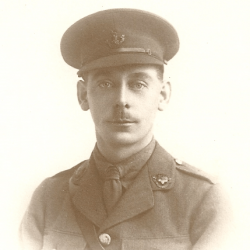
This page provides excerpts from the personal diary of Sgt. Thomas William Chisholm, of the 1/5th Northumberland Fusiliers which covers the events leading up to his capture on 27th May 1918 during the Third Battle of the Aisne and subsequently as a POW at Giessen, Darmstadt, and Lamsdorf camps, until his release on 1st January 1919. The excerpts are provided courtesy of Mike Orchard, (Sgt. Chisholm’s Grandson), and remains his exclusive Copyright. Please do not copy or reproduce any part without permission.
We can not know exactly what happened to Pte. Arthur Slater during his capture, transport and arrival at Giessen PoW camp but his experience must have been very similar to Sgt. Chisholm’s and they provide context to his story. The diary entries start in the early morning hours of of May 27, 1918 as the intense enemy artillery barrage was winding down before the German storm troops attacked the Allied lines.
Monday, May 27, 1918
Sgt. Thomas William Chisholm
The Sgt writes:
There were very few casualties considering the shell fire, but the main part had been dumped on the front and support lines, the wind blowing gently from the direction of the enemy lines reeked of powder and the sickly tang of gas. By this time about 3am our gas masks were in a bad state, the glasses were dimmed with perspiration and the waterproof bag covering was sticking to our faces and very wet, but we dare not move them owing to the risk of getting a dose of the poison. This confinement was the worst part of it because anyone who has had to wear one will know how difficult it is to breath.
Somewhere near 8am our Company Commander decided to move forward, so we headed for the cross country track so well known to us, towards the road. But this was out of the question, because it was absolutely being plastered with all sorts of iron work, and a fly could not live on it, so we were content with moving across the piece of dead ground between Concevreux and the French cemetery, it being fairly well left alone. We succeeded in reaching the rear side of the cemetery and skirted round the left side nearest the road, when suddenly the enemy barrage lifted,and seemed to drop right amongst us. Then it was for who could get forward the quickest, earth, smoke, and the moans and yells all mingled with the deepening crashes of bursting shells tended to make everyone get behind even a blade of grass.
Finally we scrambled through the cemetery and moved about thirty to forty yards in front, and proceeded to dig in with as much speed as we could, because by this time we were under distant machine gun fire as well. Things were getting rather warm and unpleasant, and owing to the smoke and the morning haze visibility was very bad, and gas masks made it much worse. Being a platoon commander I tried to marshal my men into some kind of formation, and issued instructions with regard to entrenchments and they worked like Trojans.
Inside half an hour they were fairly well off under the circumstances, in regard to cover, my orderly stuck to me very well and was remarkably cool, owing to the fact that this was the first big fight he had taken part in. He had just been transferred from R.F.C. and was really too young to be where he was, so I decided to take him under my wing to save him more or less from the arduous duties of the trench.
By this time the sun was fairly well up and the heat was beginning to itself felt, the time being somewhere about 9am we were just feeling a little bit hungry, and the men were asking when it would be possible to get something to eat, when suddenly to my surprise we were hailed from the road which lay on our left and lo and behold there were the cooks with their field kitchen with smoke pouring out of the chimneys. To say the least it was shock to see them, as it seemed an almost impossible thing for anything to move up that road. Never the less they were there and the greeting they gave us was “Howay get all this stuff off do ye want us to all get blown to hell standin’ here all day?” So I called for volunteers which soon came in the form of eight men and with a mad rush we snatched up all the dishes and made back for the trenches. I managed to get hold of the bacon and forthwith proceeded to dish it out with my hand. The grease had become cold, and it was almost hard, but we could pick out the bacon from the fat. I offered some to the O.C. Coy but the sight of the cold fat turned him against it. I think he decided that a little libation from his flask would be more beneficial.
At this point in the defense suddenly we observed two dispatch riders on motorcycles literally tearing up the road towards the front line, (which had already been pierced), and were in grave danger of running into the enemy line, but we hailed them to stop and when told of the position they soon turned about and made back towards Head Quarters. They only got about quarter of a mile back when their machines were blown from under them and they were killed.
We got something to fire at but after killing one or two owing to the haze it was discovered that they were French troops.
A CSM of the Durhams dashed over and reported that the Germans were getting round the wood on our left but the O.C. Coy denied this and told him to go to hell (personally I thought we were there already).
By 9:45am they were well advanced, and on looking behind through the information of my pal Fred, it was to see two scouts come but from behind the wood, followed by his machine gun teams, then there was a scramble to get back, but it was pretty hopeless from the first. I called my platoon to follow me as there was still a chance to get clear, so taking a course straight through the cemetery directly behind, we dodged amongst the graves and head stones as quickly as it was possible, because the bullets from both rifles and machine guns were coming like hail amongst us, but we were rather lucky with regard to casualties as there were very few hit, some being killed outright, and so far as I could gather about three of the boys wounded, including my batman and runner through the left shoulder. On reaching lower ground these were dressed and we made straight for the River Vesle, where there were bridges at intervals. We scurried forward but when we were about a hundred yards from the first bridge a deafening report rent the air and our hopes were dashed as the bridge went skywards in a million pieces. Nothing daunted we made along the river bank towards the next one but our Royal Engineers were doing their work thoroughly and up went another three. There was nothing left to do but stand fast and await events.
The heat was almost overpowering, when an officer, one of the platoon commanders came forward to me to enquire as to what I thought we had better do next. Well on going through the trees which lined the river bank, we saw a rare sight and soon drew back under cover again to hold a short consultation. In the end he wanted to reorganize and make a bayonet charge, but that solution was out of the question, owing to the fact that on the other side of the trees were something like three hundred disarmed British troops being covered with three machine guns and three flame throwers or liquid fire machines, s that any attempt at attack would have meant wholesale slaughter of all those men, so I gave him my opinion, and acted upon it without his permission. In fact I ordered him to dump his revolver and equipment in the River Vesle and keep only what was required for personal use. The Lewis guns I had brought forward and placed on the ground, put a couple of round through the machine and pitched into the air.
This part of the program completed we rather gingerly moved once more through the trees into the open where all the captives we being horded together like a lot of terrified sheep, not knowing what was going to happen next. Also the very piece of ground I have already mentioned, was the natural basin, but the position of the troops being reversed, the enemy having a strong advantage over us, by having his formidable weapons mounted on the long wood tressle bridge, which being at a height just suitable for a massacre should his gunners and fire operators desire, and I may say it was expected every second. Owing to our numbers it was thought that they would not trouble to take us prisoners.
Meanwhile his troops were trying to get something like five to six hundred British on to this bridge, and when it began to creak and crack there was a panic, so he decided it would be better to form up on terra firma and march us onto the main road.
The time being about noon judging by the position of the sun, we were unceremoniously formed into fours on the main road moving in the direction of Guignicourt.
We had proceeded for about quarter of a mile, passing through the enemy lines of advancing troops. First came his infantry, followed by light mortars, heavy mortars, machine guns, pioneers filling up all shell holes as they came forward to enable the transport to come in comfort along the roads. Next came medical services, followed by fairly solid lines of artillery in order of merit, light field guns, howitzers, then all his heavy guns, and coming pretty close again were the observation sections mounted on motor lorries. The wheels of these lorries were not tyred in the usual way with rubber, but round the rim was a series of coil springs kept in place by an outer tyre of flat steel band, thus when moving over rough surfaces these springs could take the shock and jolt similar but not so good as the rubber tyre. Above us were the huge sausage shaped balloons hundreds of feet in the air watching with all eyes, the advance in the forward areas.
One incident which happened goes to prove some of the almost unbelievable atrocities which the enemy committed during the war and a few of our boys being almost in the rear of the column witnessed it without being able to give a helping hand so just had to bear it and keep moving.
It was when their Red Cross men were coming over the ground passing our killed and wounded and not offering to give a hand to relieve their sufferings in the least. (I might mention before going any further that these supposed Red Cross people unlike our R.A.M.C., were armed with an automatic revolver, cartridge pouch and bayonet.) This particular German walked over to a man lying with his guts hanging out having been hit with a piece of flying shell, the man was doomed in the first place as it was really no good trying to patch him up, but the German walked up to him, and trying to raise himself on one arm asked for water. The swine just shook his head saying ‘Nein, nein, nein nix wasser’. The tommy, who was a Durham man opened his breast pocket, took out his wallet and offered him a fifty franc note, again gasping out ‘Water, water’. At this the Gerry took everything from him and drawing his bayonet, slashed him across the mouth. The man then lost consciousness and with a howl, we started forward to attack but being without arms we could do nothing and our guards, for there were plenty of them and big ones at that, with a yell of “Rouse!” or words meaning to ‘get back’, we could do nothing but grit our teeth and with a few curses the German moved on his way, and we were marched in the opposite direction. We never saw our comrade no more, for he was sure to die a brutal and inhuman death.
We continued our journey along the river road and three hundred yards further on came across some of his General Staff mounted on horse-back. One gentleman in particular, having under his arm an English loaf of bread and a jar of jam. It seems hard to believe, but never the less quite true. There he sat watching prisoners move past, and he, every now and then tearing a handful of bread would dip it into the jam, and eat as if his very life depended upon it.
Another quarter of a mile or so and we were passing in the shadow of the great California Plateau, and on looking up to the top most point we could see a crowd of German officers and a few yards ahead of them there was standing a solitary man standing with his cape gently blowing in the breeze. This man proved later to be the great War Lord of Germany, the Kaiser himself watching his troops doing their work of destruction as they moved forward.
The heat of the day was at it’s worst now and we were beginning to feel the effects and wondering when we were going to get a halt and something to eat because the last good meal we had was about 4:30pm on Sunday afternoon and it was now 2:30pm on Monday. We had no water either to fall back on as a reserve having dumped all before being taken, so we just trudged along, Fred No 1 on the right, myself on the left and being supported by us was Fred No 2 my batman, as we had to carry our own wounded, and with no idea where we were bound for, what with our sore feet, parched throats, the heat together with the groans from Fred 2 it was a very unpleasant position to be in. Fred 1 cursed the square head fluently all the way.
This continued until 6:30pm without a spell, when we arrived at a fairly large barbed wire compound and being counted when passing through the gate, all this done the gate was securely locked and surrounded by guards. On looking round there was no chance of escape.
Next we were fed our first meal in captivity. Well, now came a problem. Having no small kit what were we going to get this meal in, and what to eat it with? Fred 1 came to the rescue, taking off his steel helmet, he tore out the lining and low and behold there was as good a soup bowl as one could wish to have. Many followed likewise and forming up in the line, arrived at the boiler from which a German with a litre measure, dished out a white liquid, which turned out to be nothing else but flour and water boiled, so putting our helmets to our lips we drank deeply. Hardly had this been done when we were moved into a more remote corner of the compound for the night, and it was a cold one.
Everyone huddled together in the open, without any sort of covering, in an endeavour to keep warm. The outside men, one of them being me, had to keep turning over from back to front as required.
So ended the 27th May as my first day as a prisoner of war.
Tuesday, May 28 – Friday May 31, 1918
Sgt. Thomas William Chisholm
The Sgt writes:
At 5:30am the rouse came again, and with another drink of flour and water we were turned into a large field just over the other side of the hill. When this was done Fred 1 said ‘I wonder what they are going to do now Bill.’ ‘God knows, and he won’t split.’ say I.
So sitting for a short while we watched Jerry’s movements, until Fred 1 said ‘Billy if you want to keep anything you value get it smuggled quick because they are searching every man.’ But it had to be done under cover because Jerry was watching with an eagle eye, so covering each others movements, we transferred each articles we wished to keep, down inside our trousers, or in our boots. I happened to have in my possession four one mark notes, having taken them from a Jerry prisoner in a previous engagement, so Fred says ‘For goodness sake get rid of them or when they see them your days are numbered,’ so with my jackknife I dug a small hole in the ground and buried them, and with a sigh of relief joined the line to be searched.
The number to be searched being so large, it was surprising that the searching was such a short affair and when we had passed through we were minus our jackknives, and any other small articles that would be of any use to our guards. This being done we found ourselves on the road to God knows where, the order was given to march so off the column trudged, the time being about 10am.
After about four spells that day we came to a place called Lislet, this place boasted a proper prison camp, and all were put into huts no matter what rank they held, by the time this was done it was 10:30pm this practically ended our second day as prisoners. The huts were fairly large and roomy but they were packed to suffocation, however it was much better than being out in the open. The camp being a big one was built in the form of a hollow square and surrounded by a double wall of barbed wire twelve feet high. Outside this was a small embankment four feet above ground level which was used by our guards as their beat and they had to walk up and down towards each other.
By 12pm all was quiet, as we were dead tired and needed as much sleep as possible, owing to the fact that we did not know what the morrow would bring, but about 2am we were awakened by a loud whirring sound, so going outside to investigate, I found out that our aircraft were on the way and it proved quite true because when they came overhead and dropped their first bomb Jerry disappeared with a squeal and we saw no more of them until the raid was over. That caused us to get a good strapping from Jerry next day.
We rested two days in the camp. All there was to do was just walk round and get in touch with a few of the boys we had not seen since our capture, and feed upon the soup very kindly given to us by Jerry with the intention of keeping us alive but it was really just a long drink. We were also given a small piece of black bread, we looked at each other before starting to eat, however Fred and I thought we would sample ours but owing to its bitterness we could not finish it, so some of the less particular of the boys made short work of it.
By this time my wounded batman Fred 2 had been taken away from the party and put in a hospital somewhere. Whatever happened to him I never knew, for he was never seen again
This camp and the rest seemed to do us a good deal of good, but being unable to either wash or shave, we did look a grubby crowd. On the second day I happened to meet my old Company Commander who seemed in a very cheerful mood. We had a good chat over past events and parted, to see no more of each other until about twelve months after I returned to England.
That brought the day to the 31st May 1918 a Friday, and rumours that night, that we were to move again on the morrow.
Saturday, June 1, 1918
Sgt. Thomas William Chisholm
The Sgt writes:
Up at 4am and partaking of coffee and black bread we marched off again, this time under the charge of a guard of stalwart but rather old Prussian Guards mounted on very pristine horses who continued to trot backwards and forwards along the column keeping a very sharp eye on all that happened.
Getting on for about noon this day, the column were passing through a series of small villages, and by this time, we were again in no fit state to march so far without a break, but our guards kept us on the move all the time. Owing to the bad state of the roads and intense heat, we were all covered with a good coating of white dust, with streaks down our faces where the perspiration had been running down. Our mouths parched with thirst, sore feet, stiff limbs and sick of heart through this heartless treatment, we were passing through the village of Liart. The peasants noticed our plight and seemed to take pity on us, as they put outside the houses, small wooden tubs of clean fresh water for drinking. Without attempting at any halt to enable us to refresh ourselves, our guards rode forward and willfully turned over the tubs and forced us back into the ranks again. We just trudged forward very little being said, owing I think, to the fact that we wanted to save our breath as much as possible for our exertions.
We continued moving past fields looking more cultivated than the ones we had left behind, and great woods of giant fir trees. The time was somewhere about 6:30 or 7pm, when we suddenly left the road and entered one of these dense woods. Moving across a beaten track, we continued for something like half an hour before coming into the open again. Then across country for about half a mile and then came to a halt.
We had arrived at Hirson, a fairly large French town dominated by a fortress on the Borden. It was into this, that we were to rest for the next 24 hours. The Fort de Hirson, being surrounded by walls built of huge pieces of rock, this retaining wall afforded very little chance of escape. Also last but not least a large moat about 35 to 40 feet deep and 30 feet across the top.
The time being somewhere about 7.30pm, the light had not begun to fail yet so we to set off to explore our prison, in an effort to find a decent resting place, before dark came upon us. Wherever we looked, it was all the same, great towering walls faced us, so we just had to be content with a place against the wall, wherever a space could be found. Just imagine what it would be like when something like 8 or 9 hundred people tried to line a wall and find a comfortable place to lie.
Fred and I squatted down in a place as near as possible to the entrance thinking of an early exit next morning. Hunger was growing at our stomachs as we had had nothing to eat all day and it looked as if nothing was forthcoming. Even if we could have got a smoke it would have been better than nothing, but not being in the possession of the necessary articles, we had to do without. Fred however, was not to be outdone. Having a supply of cig papers, as he always did make his own cigs (like all men in the service of the merchant marine) finding a large heap of the refuse in one corner of the moat, being a dump used by the Germans, for all scrap such as potato skins, tea leaves etc., Fred managed to manufacture a cigarette by using the tea leaves and powdered dry grass. As for myself I usually smoked a pipe, so I properly filled up and smoked, but the taste and smell was nothing on earth however I stuck at it until satisfied.
All this time the people up above (French and German sight seers), who had turned out in full force to see such a large batch of British prisoners, were talking among themselves and occasionally jibing at us, intending I suppose, in making us feel our position a little more acute. So when we did understand anything that was said, it did not take long for us to give them a suitable answer, which was not always in the best of English language (some people call it ”choice”).
Our visitors keep tormenting our hunger, by displaying large pieces of sausage, bananas, and black bread, but by only dropping the skins into the moat, they seemed to enjoy seeing the boys make a rush for them. Personally I have never been nearer to being an animal than at this particular period. All that we wished for, was that we had been shot dead in the first place.
Eventually with the darkness, the crowd up above drifted away, and quietude rained.
Sunday, June 2, 1918
Sgt. Thomas William Chisholm
The Sgt writes:
The day passed without event, and on the night all that could be seen or heard, was the sentries feet and the figures of the guards moving along the stone coping round the top of our prison, and the groups of prisoners down below, on their damp cold ground beds, talking about anything that seemed to come into their heads.
Some talked of home and what their people would have to say when they heard of their sons or fathers plight. Others grumbled at the hunger and the cold, whilst some even tried to brighten our burden by singing the war marches that we had sung during happier days.
Eventually all was silent and the more contented slept fitfully throughout the night (which now seems a nightmare after all these years, but is as fresh in my memory as if it had happened last week).
Monday, June 3, 1918
Sgt. Thomas William Chisholm
The Sgt writes:
Morning came bright and fresh, but no grub. At about 7am we were all hussled out of the hell hole to a railway station and put aboard the train and rolled away again, arriving about 3.30pm at the town of Giessen.
De-training here, we marched through the streets to the other side of the town and were put into a real and proper prison camp, which was fairly large, containing good huts.
During our march through the town, we noticed the streets were spotlessly clean, also proving as to what a state of depression and starvation the German nation had been reduced to, we noticed in a few instances concessionary shop windows with not the usual display of goods, but in their place were coffins, also in drapers, and bakers shops, the same thing meet our gaze.
We were met at the entrance to the camp by other prisoners who had been in captivity a good while, but who also looked as if had done them good. They had a well fed appearance and were very well clothed, being dressed in the regulation uniform prescribed for British prisoners of war. It was made of the same material as our usual service dress, only it was dyed black with a brown band around the right arm and a two inch brown strip down the sides of the trousers. Not having seen this before, we decided it looked rather funny, but all the same, comfortable, seeing as by this time our own uniforms were looking and feeling the worse for wear.
These men who had been prisoners for a considerable period welcomed us with the news that there was a feed ready for us. I might say that we all seemed as though we needed one, judging by our friend’s appearance, because he did look well fed.
As soon as we were put into our various barracks, the food was brought and placed between the huts, where we all formed into eager queues and a German Pastern or sentry issued out the soup with a litre ladle with a handle about four feet long. As soon as a man obtained his portion, he returned to the hut to which he belonged, to partake of the first substantial meal we had had for days, which also proved very much insufficient, for our most starved condition however, it had to do, as there was no more to get.
Following this meal we were again turned out on parade and this time an RSM who had previously belonged to the Rifle Brigade carried out a nominal roll of all men in our batch. That is the only name it is possible to find for such a mixed crowd.
Followed by the RSM, came a German officer with his followers. He spoke very good English, so before ever he got anywhere near to where Fred and I were, it was passed up the ranks that he was making enquiries with regard to what trade we worked at before the war, and also that he seemed to splitting us into distinct parties. Fred and I having being pals so long now, we did not feel inclined to part, and thinking that this officer was looking for tradesmen with a view to placing us in his factories, thus relieving more German soldiers to go to the front. Fred and I had a little talk and decided that I was to tell them that my trade was a blacksmith and also that Fred had in peace times, been my striker, although he had really never seen inside of a blacksmith’s shop. Nevertheless the gag worked and we were both put into the squad containing such tradesman as engineers, both mechanical and electrical, boilermakers, blacksmiths and motor mechanics etc., so we felt fairly safe for the time being.
When all this had been done, the complete roll was called, and not being content with this, the officer and the German Sgt. Major counted us three time in succession to make sure that it corresponded with his numbers in the first place, and the roll that the British RSM had made, ensuring that no one had escaped during the journey.
Finally the dismissal came and we were told that another meal would be forthcoming somewhere about 10.00pm but it never came yet so we laid down each beneath his one blanket and slept a good sound sleep also the first of its kind, as up till now we had to sleep without any covering at all.
This ended June 3rd 1918.